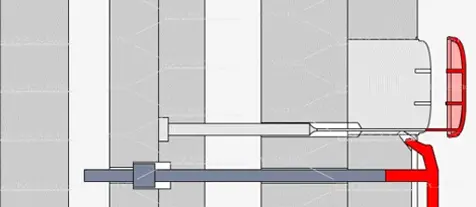
The sprue — also called the direct gate — is the first channel that molten plastic enters when flowing from the nozzle into the mold cavity. It serves as the bridge between the injection machine nozzle and the runner system, as shown in Figure 1-1.
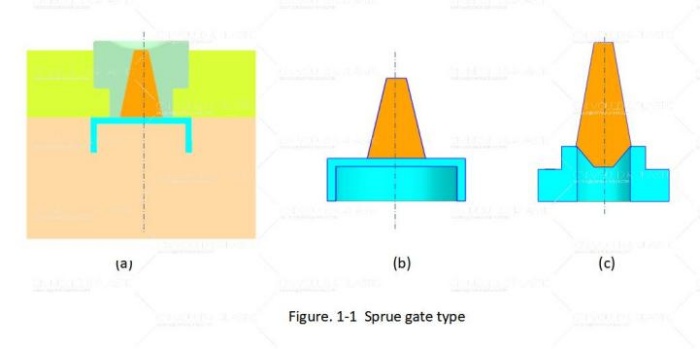
This design is typically used for single‑cavity molds and deep‑cavity shell‑shaped or box‑shaped parts. For thin‑flat parts or components prone to warpage, however, it is not recommended.
Advantages:
Short melt flow path and fast filling
Low flow resistance and good pressure transmission
Strong packing and compensation effect
Helps with venting and reducing weld lines
Simple and compact mold structure with low material waste
Disadvantages:
Gate removal is difficult and leaves visible marks
Heat concentration at the gate area delays sealing
Higher internal stress and increased risk of voids or sink marks
Design Requirements
During molding, the injection nozzle repeatedly contacts and separates from the mold gate. To ensure proper alignment and extend mold life, a sprue bushing is required.
Key dimensions to consider:
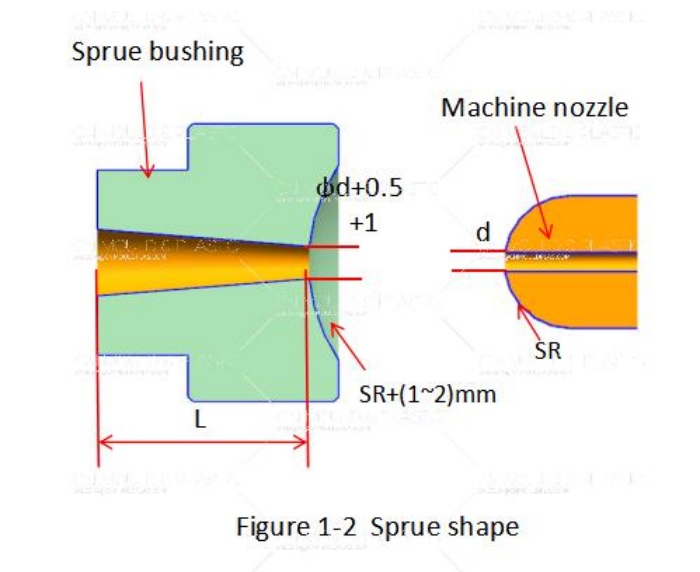
Inlet diameter – Should be 0.5–1.0 mm larger than the nozzle diameter. The spherical radius at the contact point should be 1–2 mm larger than the nozzle tip radius to ensure proper sealing and prevent flash (see Figure 1-2).
Sprue length – Optimal range is 50–60 mm (minimum 20 mm). For ABS, do not exceed 80 mm. For HCPP, up to 152.4 mm is acceptable.
Taper – A taper of 1°–3° is required for easy ejection.
Surface finish – Internal surface should be polished to Ra 0.8 μm or better.
Radius at sprue exit – Improves melt flow and ensures smooth transition to the runner.
Cross‑section – Typically round for easy machining. Minimum diameter is determined by part weight.

 English
  français
  Deutsch
  Español
  italiano
  русский
  português
  العربية
  dansk
dansk  Suomi
Suomi  Svenska
  norsk
norsk