Sprue breakage is a common issue in injection molding. When the sprue — the solidified material in the main flow channel — breaks off during ejection, it can cause production delays and even mold damage if fragments remain in the system.
Here’s what causes it and how to fix it.
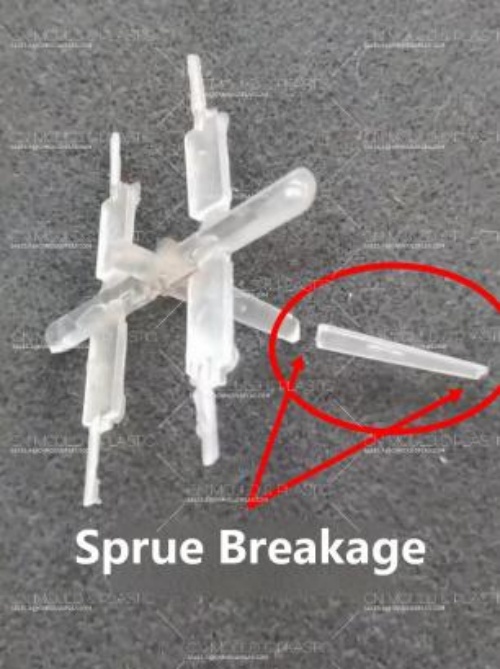
Causes
Low melt temperature – When the melt is too cool, it doesn’t fuse properly, resulting in weak material strength at the sprue. The sprue becomes brittle and prone to breakage.
Excessive regrind or poor blend compatibility – Using too much recycled material, or mixing incompatible resins, can reduce the overall strength of the molded sprue.
Nozzle misalignment – If the injection nozzle is not perfectly aligned with the sprue bushing inlet, the melt flow is restricted and uneven, creating weak spots — this is one of the most common causes of sprue breakage.
Overheated melt – Excessive temperature degrades the material, reducing its mechanical strength and making the sprue more likely to snap. This is often accompanied by discoloration or burn marks on the sprue.
Solutions
Increase melt temperature – Raise the barrel and nozzle temperatures to improve melt flow and fusion strength.
Adjust the material formulation – Reduce the percentage of regrind and ensure consistent material composition.
Realign the nozzle – Adjust the injection unit so that the nozzle is properly aligned with the sprue bushing inlet.
Lower melt temperature and injection speed – If degradation is the issue, reduce temperature and slow down injection speed to prevent overheating.
Case Example
On a PC part, the sprue was originally designed with a maximum diameter of only 7 mm, and the runner was narrow and sharp. The sprue broke frequently during production, causing recurring downtime and quality issues.
After analysis, it was determined that the breakage was caused by two factors: the small sprue diameter created excessive shear heat during filling, which led to localized material degradation and loss of mechanical strength near the sprue base; and the sharp, narrow runner cross-section acted as a stress concentration point during ejection, causing the sprue to snap at the thinnest section. In other words, the problem was not just "too small" in a single dimension, but a combination of flow-induced material weakness and mechanical stress concentration at the transition zone.
The design was then modified: the sprue diameter was increased to 12 mm, its length was shortened to 60 mm, and the runner and gate sizes were enlarged accordingly. These changes reduced the shear rate and resulting heat generation during filling, minimizing degradation; increased the cross-sectional area at the critical stress point, distributing ejection forces more evenly; and improved melt flow to reduce pressure loss, enabling a more stable filling process. After the modifications, the breakage problem was eliminated, and production efficiency improved significantly.

 English
  français
  Deutsch
  Español
  italiano
  русский
  português
  العربية
  dansk
dansk  Suomi
Suomi  Svenska
  norsk
norsk