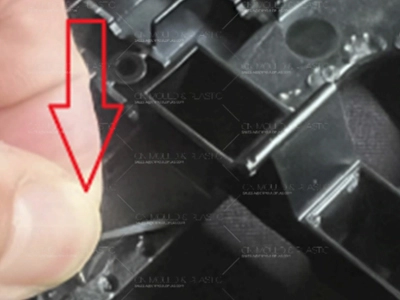
Sticking parts are a common frustration in injection molding. When the molded part refuses to release cleanly from the cavity, it slows down production and can damage both the part and the mold. This guide covers sticking issues in thermoplastic injection molding.
Several factors can cause sticking: insufficient draft angle, rough mold surfaces, excessive packing pressure, or inadequate cooling. The root causes typically fall into three categories: material issues, mold design, or process conditions. Here‘s how to diagnose and fix each.
Material Issues
High melt viscosity – Thermoplastics with high viscosity (like PC or PMMA) tend to stick more. Consider using a grade with better flowability or increasing melt temperature to reduce viscosity.
Insufficient lubricant additives – Some materials benefit from internal lubricants. Check if the grade already contains them, or consider adding an external mold release agent.
Material degradation – Degraded material can become tacky and adhere to the cavity surface. Avoid excessive residence time in the barrel and ensure proper drying before molding.
Mold & Part Design
Insufficient draft angle – Increase the draft angle on both the part and the mold to reduce friction during ejection.
Rough cavity surface – Polish the mold cavity and core to lower surface roughness. A smooth surface releases the part more easily.
Inadequate venting – Poor venting can create a vacuum behind the part during ejection. Add or enlarge vent slots to allow air to enter and break the vacuum.
Deep undercuts or aggressive texture – These can mechanically lock the part in the cavity. Reduce texture depth or add additional ejection features.
Poor ejection system design – Insufficient number of ejector pins, uneven placement, or undersized pins can cause sticking. Increase pin size and count where possible, and ensure even distribution across the part.
Process Conditions
Excessive packing pressure or time – Overpacking forces more material into the cavity, making the part tighter against the mold surface. Reduce packing pressure or shorten packing time to ease ejection.
Insufficient cooling time – If the part is ejected too warm, it may deform or stick to the mold. Extend cooling time or lower mold temperature to ensure adequate solidification before ejection.
Uneven mold temperature – Temperature differences across the cavity cause uneven shrinkage, which can lead to localized sticking. Check the cooling channels for blockages and ensure uniform temperature distribution within ±5°C across the cavity.
High injection pressure – Excessive fill pressure can create mechanical locking. Lower injection pressure to reduce packing against the cavity surface.

 English
  français
  Deutsch
  Español
  italiano
  русский
  português
  العربية
  dansk
dansk  Suomi
Suomi  Svenska
  norsk
norsk