Polymethyl methacrylate (PMMA), commonly known as acrylic or Plexiglas, is best known for its excellent optical clarity. It is one of the most widely used transparent plastics in injection molding. Most PMMA resins used for injection molding are produced by suspension polymerization. A special grade, PMMA 372, is a copolymer of methyl methacrylate and styrene (approximately 85:15), which offers improved flow and processing characteristics.
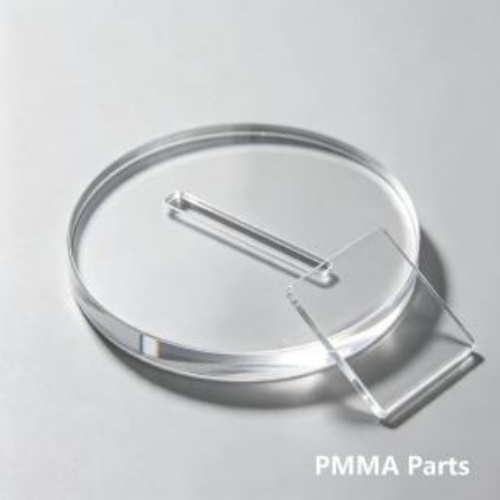
Key material properties
PMMA is an amorphous polymer with a glass transition temperature (Tg) of 105°C, a melting point above 160°C, and a decomposition temperature exceeding 270°C — giving it a relatively wide processing window. In the melt, it has high viscosity and poor flowability, and its viscosity is highly sensitive to temperature. Adjusting melt temperature is the most effective way to control flow.
PMMA is hygroscopic, absorbing 0.3–0.4% moisture. This moisture causes bubbles, silver streaks, and reduced transparency, so thorough drying is essential. Cleanliness is also critical — even small contaminants become visible due to light refraction. PMMA is hard and brittle, so careful attention must be paid to shrinkage and draft angles.
Part and mold design
The recommended flow-length-to-wall-thickness ratio is 130:1. Minimum wall thickness should be 1 mm (0.8 mm for PMMA 372), typically 1.5–5 mm. Avoid sharp corners; use radiused transitions.
Shrinkage is 0.5–0.7%, but generous draft angles are needed — 30′–1° for cores, 35′–1°3′ for cavities, larger for complex parts. Use 0.03 mm or less venting depth to reduce weld lines. Choose thin, wide gates.
Mold temperature is typically controlled by water cooling. For thick or complex parts, use heated control at 40–60°C (max 80°C), with core/cavity temperature difference within 10°C. The mold must be highly polished; chrome plating is recommended. Use as few ejector pins as possible.

 English
  français
  Deutsch
  Español
  italiano
  русский
  português
  العربية
  dansk
dansk  Suomi
Suomi  Svenska
  norsk
norsk