ABS is a terpolymer of acrylonitrile, butadiene, and styrene. Each component contributes different properties, and the ratio between them determines the material's final performance. Additives also play a role, creating a wide range of grades with distinct characteristics. In China, common ABS grades include general-purpose, extrusion, high-flow, heat-resistant, low-temperature, flame-retardant, and plating grades.
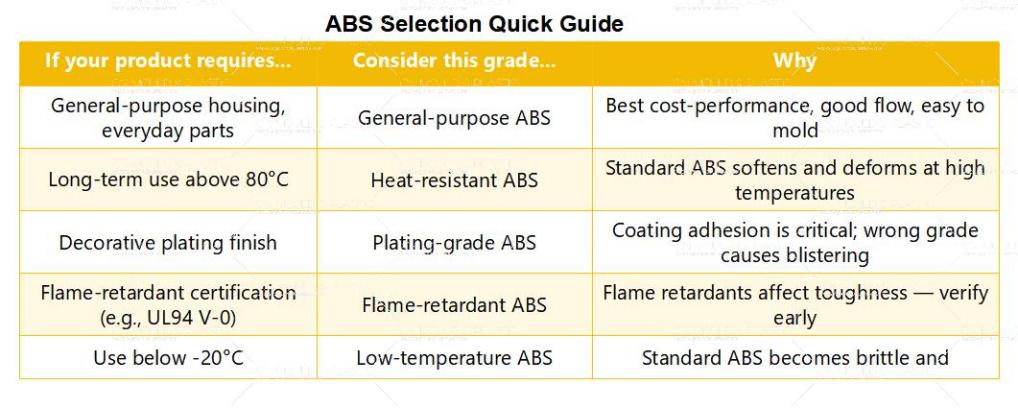
Still not sure which grade to pick? The table below gives you a quick reference based on what your product needs.
General-Purpose ABS
This is the most common choice for injection molding. It contains no special additives, offers good flow (melt flow rate typically 1.5–10 g/10 min), and is available in many grades.
Based on rubber content and impact strength, general-purpose ABS can be classified as:
Medium impact – rubber content 8–14%
High impact – rubber content 14–18%
Ultra‑high impact – rubber content above 18%
These grades are widely used for housings, automotive parts, electrical components, mechanical parts, refrigerator liners, lighting fixtures, furniture, safety helmets, and general goods.
Heat‑Resistant ABS
This grade is produced by copolymerization (e.g., replacing styrene with α‑methylstyrene) or by blending with heat‑resistant polymers like PC or polysulfone. It offers better heat resistance than general‑purpose ABS and is used for applications requiring elevated temperature performance, such as housings and instrument panels.
Low‑Temperature ABS
This grade performs well in cold environments, with impact strength maintained down to –60°C. It is suitable for injection molded parts used in freezing conditions or cold climates where standard ABS would become brittle.
Flame‑Retardant ABS
Flame‑retardant ABS is produced in two ways: by adding flame retardants (such as brominated compounds), which may reduce toughness, or by blending with inherently flame‑retardant resins like PVC. The ABS/PVC blend offers good flame resistance and is commonly used for computer and telecommunications equipment housings.
Plating‑Grade ABS
This grade provides better adhesion to metal coatings than general‑purpose ABS. After electroplating, parts gain improved aesthetics, reduced thermal expansion, and enhanced surface conductivity and heat dissipation. Plated ABS is used as a metal substitute in automotive parts, instrument housings, decorative components, and furniture hardware.

 English
  français
  Deutsch
  Español
  italiano
  русский
  português
  العربية
  dansk
dansk  Suomi
Suomi  Svenska
  norsk
norsk