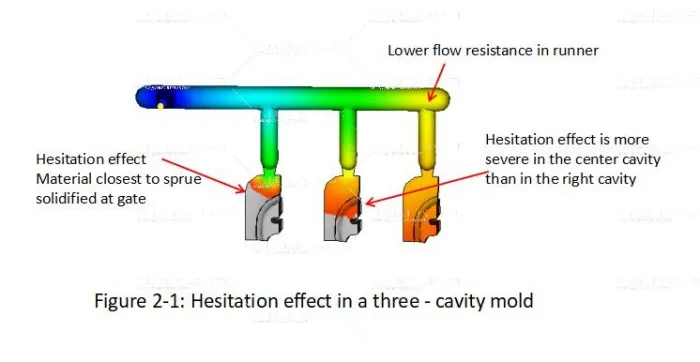
Hesitation effect — also known as flow hesitation or stagnation — occurs when the melt front slows down or stops at thin sections (such as ribs or thin walls) during cavity filling. The melt prefers to flow through thicker, less restricted areas first. When it reaches a thin section, it encounters high flow resistance and pressure loss, so it waits until the thicker sections are filled. Only then — often during the packing stage — does sufficient pressure build up to fill the thin area.
By the time the thin section finally fills, the melt may have cooled too much, causing short shots, weak weld lines, or surface defects.
Here’s why it happens and how to prevent it.
Causes
Hesitation typically occurs at thin sections — especially ribs or areas perpendicular to the main flow direction — where the melt path narrows, creating high resistance and pressure drop. Because the melt is slow or stagnant in this area, it receives no fresh hot material. Heat loss accelerates, and the material may begin to solidify before the cavity is completely filled.
Solutions
Increase the thickness of hesitation areas – A thicker section reduces flow resistance. However, avoid abrupt thickness changes, which can cause weld lines or sink marks.
Move the gate location – Position the gate so that the hesitation area becomes the last area to fill. This ensures sufficient pressure builds up before the melt reaches it.
Use materials with better flowability – Lower‑viscosity grades fill thin sections more easily and reduce the risk of hesitation.
Apply multi‑stage injection – Increase injection speed and pressure specifically when the melt reaches the hesitation area. This pushes the melt through the thin section before it solidifies.
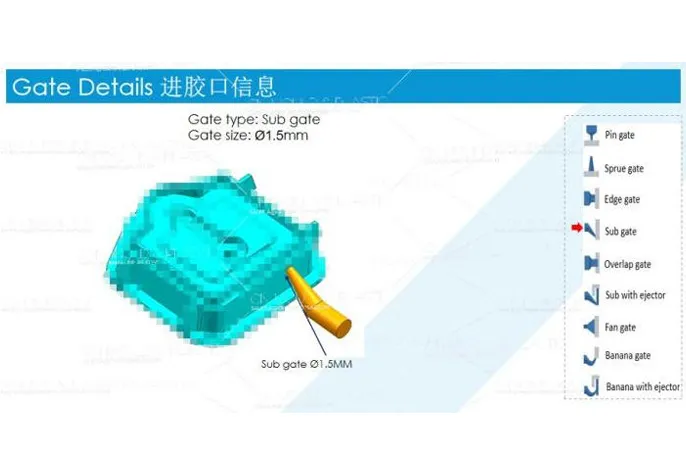
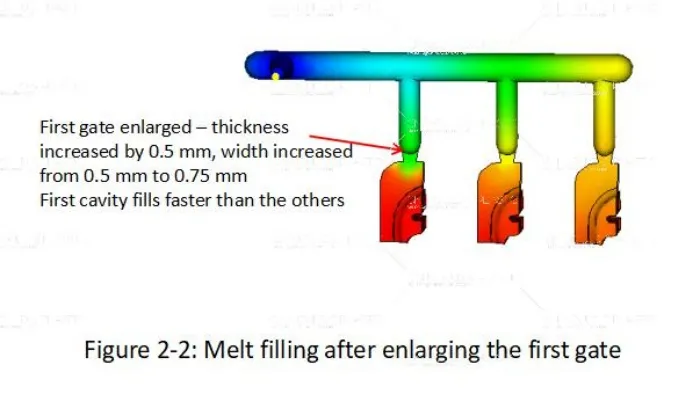
Enlarge the gate size – A larger gate reduces melt resistance and improves filling in affected cavities.
Practical example (Figures 2-1 and 2-2): In a three‑cavity mold, hesitation occurred in the cavity nearest the gate because the melt solidified prematurely at that point. By increasing the gate size of the first cavity, melt flow improved and filling became more balanced across all three cavities.

 English
  français
  Deutsch
  Español
  italiano
  русский
  português
  العربية
  dansk
dansk  Suomi
Suomi  Svenska
  norsk
norsk