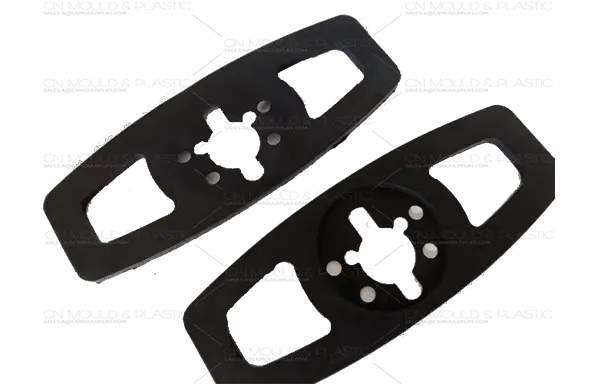
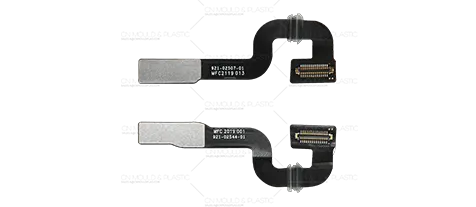
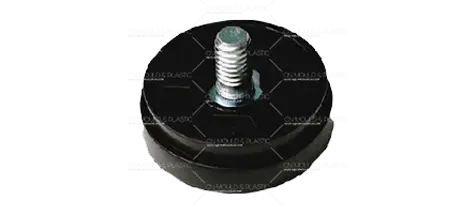
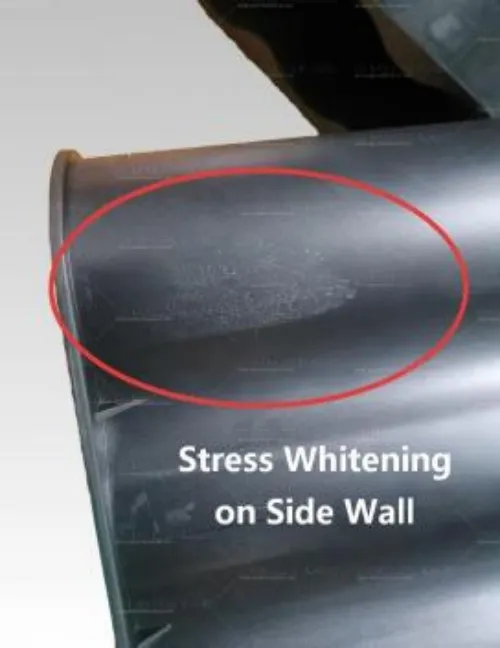
Stress whitening is a common surface defect in injection molded parts. It appears as a white or silvery discoloration on the part surface, typically near ejector pin marks, sharp corners, or areas of high stress concentration, as shown in the Figure. This occurs when internal stresses create micro‑cracks in the polymer — the cracks scatter light, reducing local refractive index and producing the characteristic white appearance.
This phenomenon is most frequently observed in materials such as PP, PE, HIPS, ABS, polymer alloys, and filled polymers.
Causes
Internal stress concentration – When parts are ejected from the mold, residual stresses build up due to differential cooling, material flow, or mechanical force. These stresses can exceed the material's local yield strength, creating micro‑cracks without visible fracture.
High packing pressure – Excessive injection pressure or packing pressure forces material into the cavity, creating molded‑in stress that later manifests as whitening.
Insufficient mold temperature or cooling time – Rapid cooling or uneven mold temperatures can cause localized stress concentration.
Ejector pin issues – A poorly finished ejector pin surface or uneven contact area on the back of the part can create localized stress, causing whitening around the ejector pin marks.
Excessive demolding force – High ejection speed or force can generate sudden stress, contributing to micro‑cracking and whitening at the ejection points.
Material toughness – Some materials, particularly those with low impact resistance or high filler content, are more prone to stress whitening under the same molding conditions.
Solutions
Increase material toughness – Use impact‑modified grades, polymer blends, or copolymers to improve the material’s resistance to micro‑cracking.
Reduce injection and packing pressure – Lower both injection pressure and packing pressure, and shorten packing time to reduce molded‑in stress.
Adjust mold temperature and cooling – Increase mold temperature to promote more uniform cooling, and extend cooling time to allow stress relaxation before ejection.
Improve ejector pin surface – Smooth the ejector pin tip and the surrounding cavity surface to ensure the part back surface is even, reducing stress concentration.
Reduce demolding force and speed – Lower ejection force and speed to minimize mechanical stress during part removal.
Post‑molding treatment – If whitening occurs, placing the part in hot water for a period of time can help release residual stresses and eliminate the white appearance.

 English
  français
  Deutsch
  Español
  italiano
  русский
  português
  العربية
  dansk
dansk  Suomi
Suomi  Svenska
  norsk
norsk