Every plastic part has critical features and non‑critical ones. Treating every surface with the same high‑precision requirement drives up mold manufacturing costs and ties up expensive equipment unnecessarily. The key to cost‑effective electrode design is to distinguish between these areas before splitting the electrode.
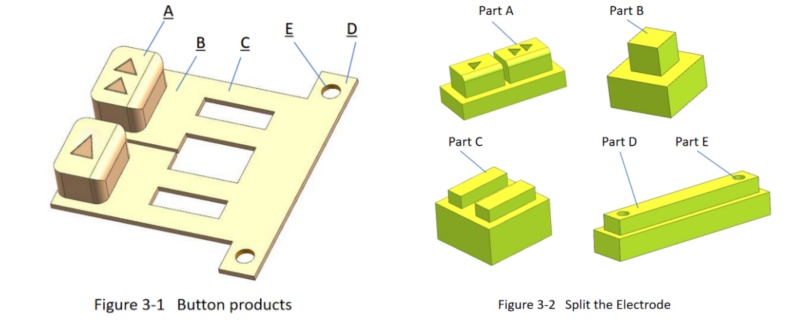
Figure 3‑1 shows a button for a radio recorder, divided into five sections: A, B, C, D, and E.
Section A – The main body. The triangular recess at the top is a functional feature with very high requirements. It must have sharp, clean corners — no radius — which makes it difficult to machine. The button also fits into the front housing, so the mating surfaces have tolerance requirements. This is a high‑precision area.
Section B – The cosmetic edge and anti‑kickback rib. Only the height dimension is critical; other dimensions have no tight requirements.
Section C – The spring arm. This is what allows the button to spring back after pressing. Only the spring force matters — width and other dimensions are not critical.
Section D – The locating base. Dimensional accuracy is not particularly demanding here.
Section E – The alignment feature during assembly. This is machined by wire‑cut EDM and is not part of the electrode.
The Problem with a One‑Piece Electrode
If sections A, B, C, and D are combined into a single electrode, CNC milling alone cannot complete the job in one setup. Additional equipment — such as engraving machines and wire‑cut EDM — would be required. That means multiple setups, longer machining time, and significantly higher costs.
Worse, a one‑piece electrode is inflexible. Mold modifications often target only one specific section. With a combined electrode, you would have to rework the entire electrode — or even start over — when only one section needs adjustment.
The Smarter Approach: Split the Electrode
Figure 3‑2 Part A: Main electrode
This is machined from a single piece of material using only an engraving machine — no CNC milling required. One setup, one process, lower cost.
Figure 3‑2 Part B: Cosmetic edge electrode
Dimensional accuracy is not critical here — only thickness matters, and thickness is controlled by the EDM machine. Therefore, this electrode can be machined on a standard milling machine, which is a less expensive operation than CNC or engraving.
Figure 3‑2 Part C: Spring arm electrode
Again, only thickness is important. Thickness is controlled by the EDM machine, so this electrode can also be produced on a standard milling machine.
Figure 3‑2 Part D: Locating base electrode
Dimensional requirements are not demanding. Standard milling machine — lower cost.
The Manufacturing Advantage
By splitting the electrode, we achieve several benefits from a manufacturing perspective:
Reduced machining cost – Low‑precision sections are processed on less expensive machines, freeing up CNC and engraving equipment for high‑precision work.
Simplified manufacturing – Each electrode is easier to produce with fewer setups and less complex toolpaths.
Better equipment utilization – CNC, engraving, and wire‑cut machines are used only where they are actually needed.
Flexibility for future modifications – Each section can be reworked independently without affecting the others, which is critical when mold modifications are required.
In mold manufacturing, cost and quality are always a balancing act. Pushing quality to the highest level across the entire part is rarely economical. Cutting costs without considering functionality is equally unacceptable. The key is to understand the actual requirements of each feature and make intentional choices — that’s where real efficiency comes from.

 English
  français
  Deutsch
  Español
  italiano
  русский
  português
  العربية
  dansk
dansk  Suomi
Suomi  Svenska
  norsk
norsk