Material Properties
ABS offers an excellent balance of properties, including good heat resistance, rigidity, chemical resistance, high impact strength, high tensile strength, low-temperature toughness, electrical insulation, and good processability and dyeability. Its main drawback is poor weather resistance. ABS is widely used for general mechanical parts, wear‑resistant and friction components, transmission parts, and telecommunications components.
Processing Characteristics
ABS is an amorphous polymer with no distinct melting point. With many grades available, process parameters should be selected based on the specific grade. Generally, molding is possible above 160°C.
ABS has a moderate melt viscosity — its flowability is lower than that of polystyrene or polyamide but better than rigid PVC or polycarbonate. The melt also cools and solidifies relatively quickly.
Injection Molding Conditions
1. Temperature Control
ABS typically begins to decompose around 260–270°C, depending on the grade. Because it contains rubber components, excessively high temperatures will not improve flowability — instead, they cause rubber degradation and reduce flowability. Prolonged high‑temperature exposure can lead to degradation, cross‑linking, and carbonization.
Recommended temperature ranges:
Plunger machine: 180–230°C
Screw machine: 160–220°C
Nozzle: 170–180°C
General rule: Use higher melt temperature and higher mold temperature.
Mold temperature guidelines:
High‑precision parts: 50–60°C
High‑gloss or heat‑resistant parts: 60–80°C
Higher mold temperatures produce glossier surfaces, help avoid weld lines and sink marks, and reduce warpage — but shrinkage increases. For shorter cycle times, lower mold temperatures (sometimes as low as 50°C) are acceptable. For large, complex, or thin‑walled parts, consider dedicated mold heating.
2. Pressure Control
Injection pressure: Generally 60–120 MPa, depending on part geometry and wall thickness. For thin walls or long flow paths with high resistance, increase to 130–150 MPa. For thick walls or large gates with low resistance, lower pressure works fine. Increasing injection pressure also improves surface gloss.
Holding pressure: This significantly affects surface quality and silver streaks.
Too low : excessive shrinkage, poor cavity contact, and surface fogging.
Too high: strong friction against cavity surface, leading to part sticking.
Holding pressure should be 30–60% of injection pressure. Fine‑tune both pressure and time for best results.
Back pressure: 0.3–1.5 MPa (3–15 bar). If back pressure is too low, air entrapment in the melt may cause burning. If too high, excessive shear heating may degrade the material.
Screw speed: Generally not exceeding 0.55–0.65 m/s.
3. Injection Speed
Medium injection speed works best for ABS. If the speed is too high, the material may decompose or even burn, causing weld lines, gloss variation, and reddening of the material near the gate. However, for thin‑walled or complex parts, sufficient speed is still necessary — otherwise, the cavity may not fill completely.
4. Molding Cycle
The total molding cycle for ABS is typically below 80 seconds — about 10–20% shorter than for many other plastics.
5. Heat Treatment
ABS has relatively low molding shrinkage (typically 0.4–0.7%), but internal stress can be high. Heat treatment is recommended: place parts in a hot air circulation oven at approximately 70°C for 2–4 hours, then allow them to cool slowly to room temperature. This helps relieve internal stresses.
Final Takeaway
Control temperature carefully, balance injection and holding pressure, and don't skip heat treatment — and your ABS parts will come out stronger, glossier, and more dimensionally stable.

 English
  français
  Deutsch
  Español
  italiano
  русский
  português
  العربية
  dansk
dansk  Suomi
Suomi  Svenska
  norsk
norsk 
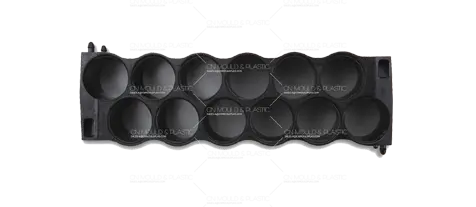
-0.webp "Acrylonitrile Butadiene Styrene (ABS)")