In mold manufacturing, the selection of a surface machining method depends on three key factors: the part shape and size, the required dimensional accuracy, and the desired surface finish. Common machining methods include turning, milling, grinding, lapping, and scraping.
The table below provides a general reference for selecting the appropriate machining route based on tolerance grade and surface roughness.
Machining Routes – Capabilities Overview
Turning is commonly used for end faces and cylindrical surfaces with perpendicular planes. A typical turning route progresses from rough turning (IT11–IT13, Ra 12.5–50 μm) through semi‑finish turning (IT8–IT10, Ra 3.2–6.3 μm) to finish turning (IT7–IT8, Ra 0.8–1.6 μm). For hardened surfaces, grinding after semi‑finish turning achieves IT6–IT8 with Ra 0.2–0.8 μm.
Milling and planing are widely used for non‑hardened planes. Rough milling or planing gives IT11–IT13 with Ra 6.3–25 μm. Adding a finishing pass improves to IT8–IT10 with Ra 1.6–6.3 μm. For higher precision without hardening, scraping after finishing reaches IT6–IT7 with Ra 0.1–0.8 μm. Alternatively, wide‑blade finish planing can achieve similar results at IT7 with Ra 0.2–0.8 μm.
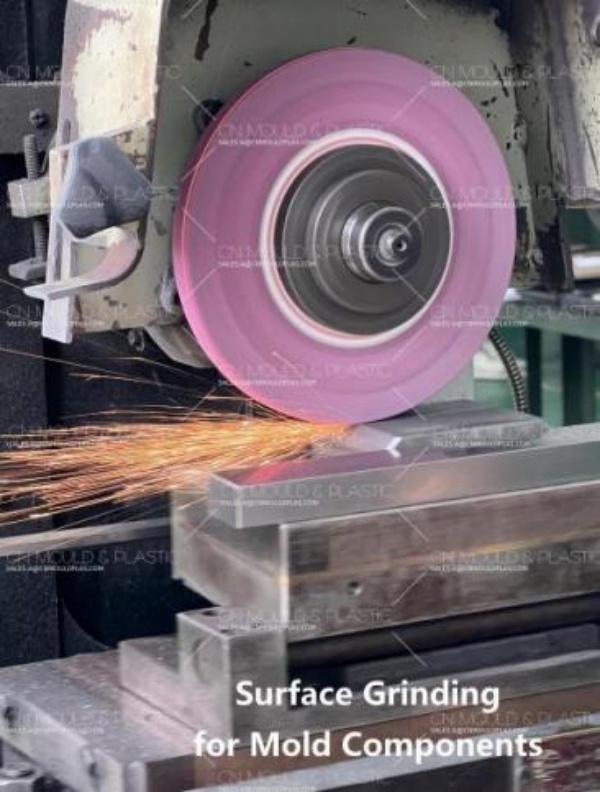
Grinding is the preferred finishing method for hardened surfaces. A typical sequence — from rough planing/milling to finish planing/milling, then grinding — yields IT7 with Ra 0.2–0.8 μm. For the highest precision, adding a second grinding step (rough grind + finish grind) achieves IT6–IT7 with Ra 0.025–0.4 μm.
Lapping and scraping are reserved for ultra‑high precision surfaces. For example, a route of rough milling → finish milling → grinding → lapping can achieve tolerances of IT5 or better with surface roughness as low as Ra 0.006–0.1 μm. Scraping is typically used for precision non‑hardened surfaces where hand finishing is acceptable.
Process Selection by Production Volume
The choice of machining method also depends on production volume. For high‑volume production, special combination milling machines are often used for planes to maximize productivity while maintaining accuracy. In small‑batch production, planing or milling is the typical starting point — planing for narrow, long surfaces and milling for wide, short ones.
For stepped surfaces or internal planes, vertical milling or slotting is commonly employed. Surfaces perpendicular to cylindrical features are usually machined in the same setup, starting with turning.
A practical rule: semi‑finishing generally follows the same method as roughing, while final finishing and superfinishing are achieved through precision grinding, lapping, or scraping. When selecting a process, consider the material condition (hardened or not), the required accuracy, and the available equipment.

 English
  français
  Deutsch
  Español
  italiano
  русский
  português
  العربية
  dansk
dansk  Suomi
Suomi  Svenska
  norsk
norsk