Two-shot molding sounds simple — one cycle, two materials, hard and soft bonded together. But the mold design behind even a small round cover can make or break production.
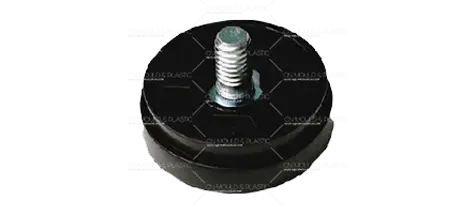
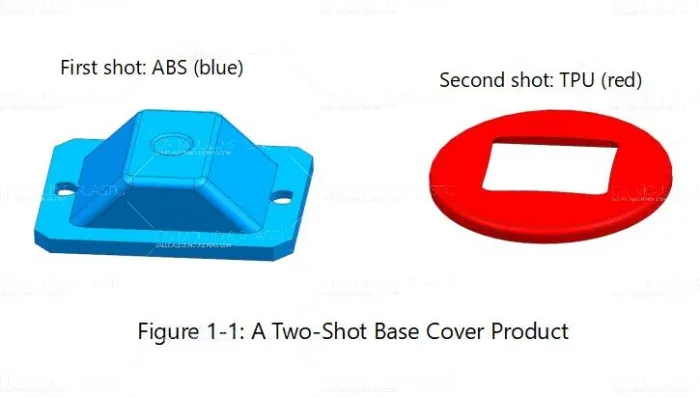
This is a 50 mm round cover, 13.5 mm tall. As shown in Figure 1-1, the blue section is the first-shot ABS hard plastic. The red section is the second-shot TPU soft rubber. The part is simple and small. The mold runs a 2+2 cavity layout — two cavities for the first shot, two for the second.
Simple part. But four critical decisions had to be made.
Decision 1: Where Does the Parting Line Go?
First, determine the ejection direction and the parting line.
The product structure is simple, so the parting line runs along the maximum contour of the product, as shown in Figure 1-2. The second-shot TPU is fully formed within the fixed mold cavity.
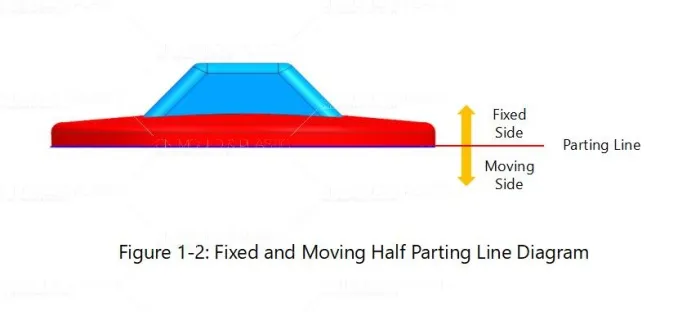
This follows the basic principle of simple two-shot mold design: the fixed mold has different shapes, while the moving mold has identical shapes.
The fixed half handles the "change" — the cavity for the first shot and the second shot are different. The moving half handles the "constant" — both shots are positioned by the same moving core.
Decision 2: Where Does the Second-Shot Gate Feed?
This is the key challenge of this mold.
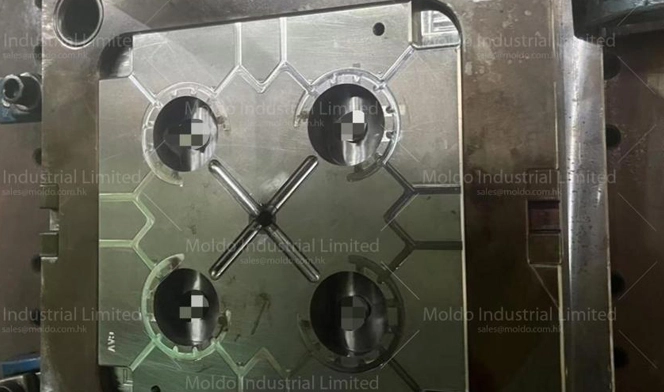
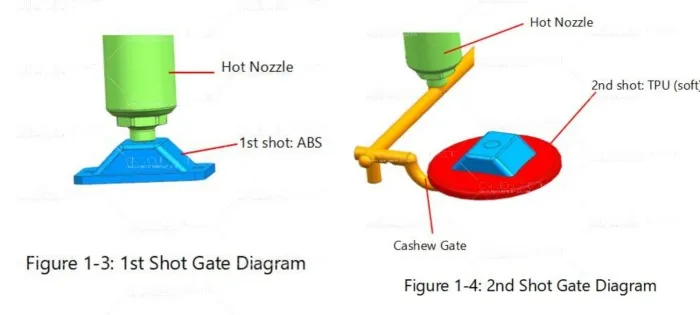
The first-shot ABS uses a single pinpoint hot nozzle, gating at the center of the product (see Figure 1-3). Cosmetic requirements are low, so center gating is fine.
But the second-shot TPU forms the external surface, so appearance is critical. The gate vestige cannot be visible.
We use a submarine cashew gate, feeding from the rib of the soft rubber — on the moving core side (see Figure 1-4). This keeps the gate vestige in a non-cosmetic area.
Decision 3: How Do You Seal Between Shots?
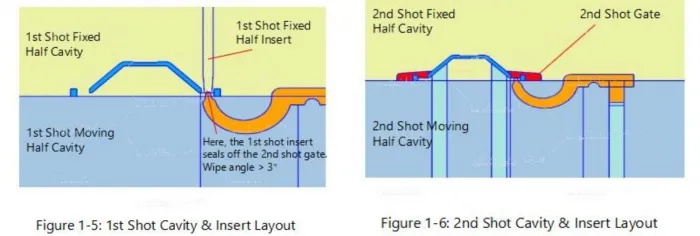
During the first-shot injection, an insert in the fixed mold blocks the second-shot gate opening to prevent the first-shot material from entering the second-shot runner .
There is a wipe-off interface between the fixed and moving inserts. The wipe-off angle must be large enough to avoid surface damage and flash. As a general rule, this angle should be greater than 3 degrees (see Figure 1-5 & Figure 1-6).
When the second-shot material is injected, the fixed insert position becomes the TPU cavity. The soft rubber flows through this opening and fills the cavity.
Decision 4: How Do You Eject?
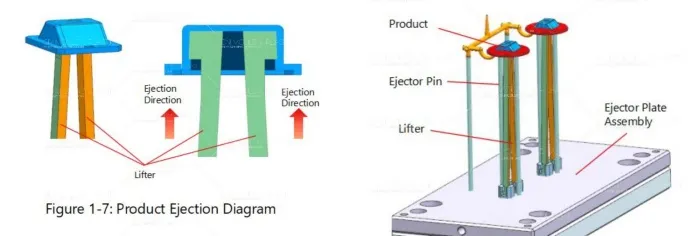
The moving half has four undercuts, handled by angled lifters (see Figure 1-7).
At each mold opening, the ejector rod at the second-shot station drives the ejector plate, which pushes both the ejector pins and the angled lifters. The second-shot product and the cold runner are ejected together (see Figure 1-8).
The moving half then rotates 180 degrees, and the next cycle begins.
That's the design — simple part, smart gate, and a little angle where it counts.

 English
  français
  Deutsch
  Español
  italiano
  русский
  português
  العربية
  dansk
dansk  Suomi
Suomi  Svenska
  norsk
norsk