In multi-color and multi-material injection molding, achieving reliable waterproofing depends on one key factor: whether the interface between the two materials forms a continuous, uninterrupted sealing path. The following sections break down the core principles from two perspectives — bonding methods and seal line design.
TPE Wrapping: One Side Is Safe, Two Sides Are Risky
Single‑side wrapping — TPE covers only one side of the rigid substrate — is the most reliable approach. The rigid insert is fully supported by the mold during the second shot, so it doesn’t shift or deform. The TPE flows evenly, creating a uniform and continuous sealing interface.
Double‑side wrapping — TPE covers both sides — is much riskier. The rigid insert is left unsupported in the cavity and can deform under high injection pressure and heat. Uneven TPE thickness leads to weak spots or separation at the interface, which creates leak paths.
If double‑side wrapping is unavoidable, follow these rules:
Keep more TPE on the appearance side
Break internal TPE sections into short, segmented intervals
Increase TPE wall thickness to compensate for possible insert deformation
Seal Line Design: Avoid Feather Edges, Use Steps or Grooves
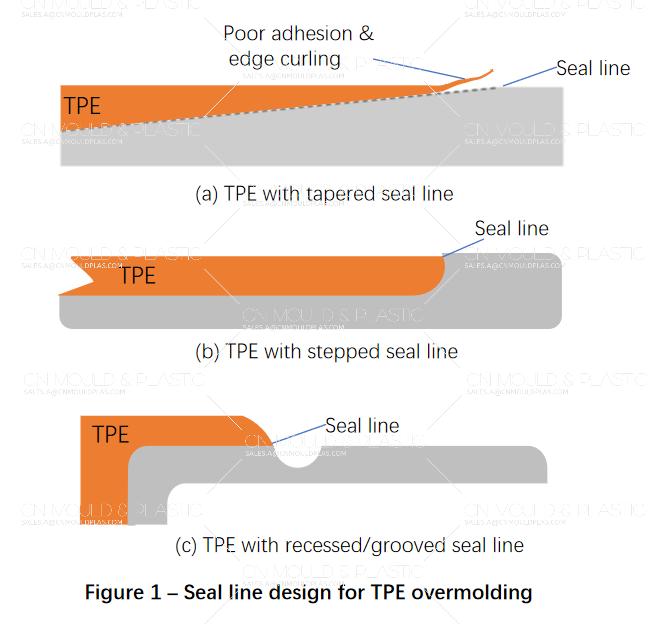
The seal line is the boundary where hard plastic meets TPE — it’s the primary attack point for moisture, so treating it as a critical design element is essential.
Avoid “feather‑edge” designs where the TPE tapers to a thin, sharp edge. Thin edges lack bonding strength and are prone to poor adhesion or edge curling — both cause waterproof failure.
Step seal line — a step is molded into the hard plastic surface, and the TPE covers the top. This forces moisture to go around a corner, making the leak path longer and less direct.
Groove seal line — a groove is cut into the hard plastic, and the TPE fills it. The TPE becomes mechanically locked in place, and even if the materials expand or shrink at different rates, the bond remains intact.
Whichever design you use, make sure the TPE wall thickness is at least 1.0 mm.

 English
  français
  Deutsch
  Español
  italiano
  русский
  português
  العربية
  dansk
dansk  Suomi
Suomi  Svenska
  norsk
norsk