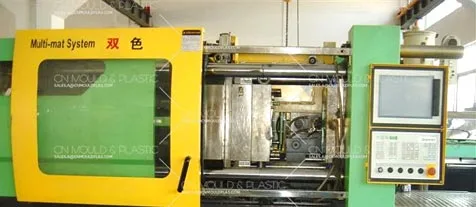
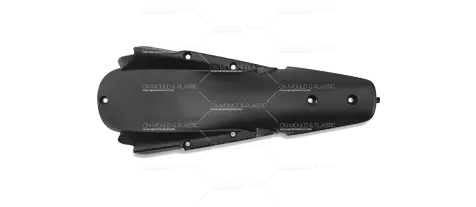
A mold is like anything else in production: if you wait until it breaks, you've already lost time and money. Wear happens. It's inevitable. But how you maintain the mold during production decides whether it lasts 1 million cycles or 100,000.
Here are a few practical things we do to keep molds in good shape — whether they're running in our shop or stored between production runs.
1. Give Every Mold a History Card
Every mold should have its own record — a "resume," if you will. When it was used. What it produced. What process parameters were used. Any wear or damage that was noticed.
Why does this matter? Because when something goes wrong, you have a paper trail. You can see which parts have worn, how fast they've worn, and whether a problem is new or something that's been developing for months. This shortens trial time and keeps production moving.
2. Know What State Your Mold Is In
When the machine and mold are running normally, test the mold's performance and record the results. Check the dimensions of the last molded part — are they still within spec? Record that too.
With this data, you can judge the mold's current condition: is the cavity worn? Is the core damaged? Is the cooling system still working? Is the parting line still sealing properly?
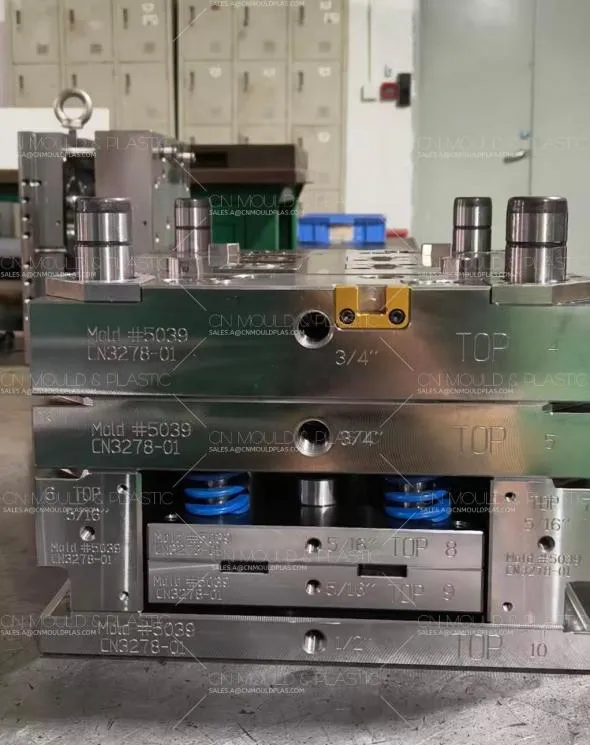
Pay special attention to the ejection system and guide components. If an ejector pin or guide rod bends or gets damaged, the mold stops. We check them regularly, and replace anything that's deformed or worn. After each production run, we apply rust-preventive oil to moving and guiding parts. Gear and rack bearings get extra attention. Spring-loaded molds get their spring strength checked.
3. Don't Forget the Cooling System
Over time, cooling channels build up scale and rust. The passage gets narrower, sometimes even blocked. When that happens, heat exchange drops, and cycle time goes up.
We clean cooling channels regularly. It's not a glamorous job, but it's one of the most important maintenance tasks.
4. Hot Runner Molds Need Extra Care
If a hot runner mold is running, the heating and control system deserves special attention. After every production cycle, we check the band heaters, cartridge heaters, heater probes, and thermocouples. If something's damaged, it gets replaced — not left to fail mid-run.
5. Take Care of the Mold Surface
The surface finish of the mold directly affects the surface quality of the parts. So we keep it clean and rust-free.
After a production run, the cavity gets cleaned while it's still warm. A copper rod, copper wire, or soapy water removes resin residue and deposits. Then it's air-dried.
Never iron wire or steel wool. That scratches the cavity surface.
If there are rust spots from corrosive resins, we polish them out with a grinder, apply a light coat of rust-preventive oil, and store the mold in a dry, cool, dust-free place.
The bottom line: Mold maintenance isn't a "nice to have." It's what keeps production running and molds alive. A few minutes of care after each run saves hours of downtime later.

 English
  français
  Deutsch
  Español
  italiano
  русский
  português
  العربية
  dansk
dansk  Suomi
Suomi  Svenska
  norsk
norsk