Rubber vulcanization is the chemical process that transforms raw rubber into a strong, elastic material through cross‑linking. A complete sulfur curing system consists of three components: curing agent, activator, and accelerator. The vulcanization of rubber is a complex chemical reaction involving rubber molecules, sulfur, and other compounding ingredients — though the sulfur reaction is the primary one.
For most sulfur‑cured rubbers containing accelerators, the chemical reaction proceeds through three stages:
Stage 1: Induction period – Activator, accelerator, and sulfur interact to form rubber macromolecules with polysulfide accelerator pendant groups.
Stage 2: Cross‑linking reaction – The pendant groups react with adjacent rubber chains to form cross‑links.
Stage 3: Network maturation – The cross‑links undergo shortening, rearrangement, and some degradation. The network stabilizes as the vulcanizate reaches its final properties.
What the Vulcanization Curve Tells You
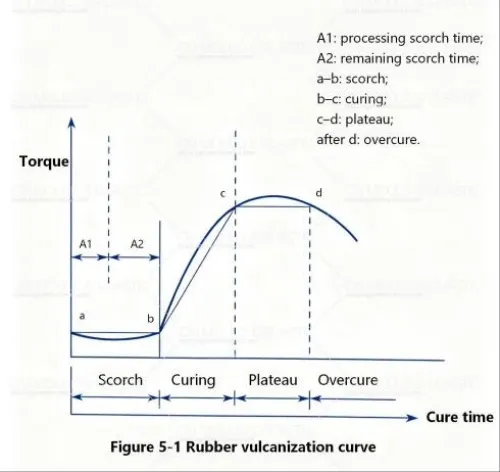
The progress of vulcanization can be observed through changes in the compound's physical properties over time. The vulcanization curve — typically generated by combining Mooney scorch and cure meter data — shows four distinct phases:
Scorch phase (a–b in Figure 5-1) – This is the induction period before cross‑linking begins. It is also known as scorch time. Scorch time consists of two parts:
Processing scorch time (A₁) – The scorch time consumed during mixing, calendering, and extrusion due to heat accumulation.
Remaining scorch time (A₂) – The time the compound remains flowable during molding or shaping.
The total scorch time determines processing safety. It is mainly controlled by the accelerator type and dosage, as well as processing conditions.
Curing phase (b–c in Figure 5-1) – This is the cross‑linking stage, during which the network structure develops. Elastic modulus and tensile strength increase sharply. The slope of this segment indicates the cure rate — a steeper slope means faster vulcanization, higher productivity, and faster cure rates, which are influenced by accelerator type and dosage, as well as curing temperature. Higher accelerator activity, higher dosage, and higher temperature all contribute to faster cure.
Cure plateau (c–d in Figure 5-1) – Cross‑linking is largely complete, and the network enters the maturation stage. Cross‑link shortening, rearrangement, and degradation occur, but the torque curve levels off. During this phase, vulcanizate properties remain optimal. The length of the plateau depends on the compound formulation, and is typically used as the range for selecting the optimum cure time.
Overcure phase (after d in Figure 5-1) – Beyond the plateau, the compound enters overcure, which can take three forms:
Rising curve – Continued cross‑linking and network stiffening, typical for non‑sulfur cured SBR, NBR, CR, and EPDM.
Falling curve – Network degradation, such as reversion in natural rubber with conventional sulfur curing, where cross‑link density and mechanical properties decline.
Flat curve – Extended plateau, common in sulfur‑cured synthetic rubbers with efficient or balanced curing systems.
How This Affects Your Production
If scorch time is too short, the compound may start curing inside the nozzle or runner before reaching the cavity — causing rough surface finish, scorched particles in the runner, or a sudden rise in injection pressure. If you observe these signs, the compound formulation needs review — your compound supplier can adjust the accelerator system to extend processing safety.
Cure rate – A faster cure reduces cycle time, but for thick parts it can cause undercure in the core. The key question: how thick is “thick”? Generally, parts with wall thickness over 6 mm require slower cure to avoid incomplete vulcanization inside.
Plateau – This is the cure window. The start of the plateau is the earliest point you can demold without risking distortion. Demolding later improves nothing — it only adds cycle time.
Overcure – Beyond the plateau, some compounds degrade. In natural rubber, this causes reversion — the part becomes sticky and loses strength. If you see this, reduce cure time or temperature.

 English
  français
  Deutsch
  Español
  italiano
  русский
  português
  العربية
  dansk
dansk  Suomi
Suomi  Svenska
  norsk
norsk