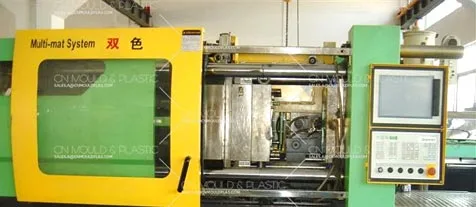
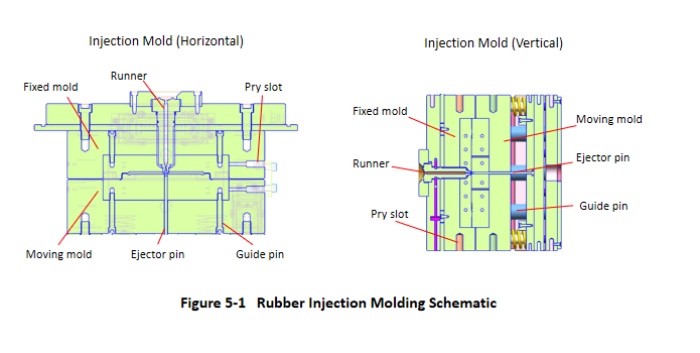
Injection molding is a versatile and high‑precision manufacturing process for rubber components. It uses a closed mold, and the uncured rubber compound is fed from the injection barrel under high shear, as shown in Figure 5‑1.
This high‑shear action offers two key benefits. First, the rubber enters the cavity at an elevated temperature, which shortens curing time — particularly advantageous for thick‑wall parts. Second, the shear reduces viscosity, creating a significant thermoplastic‑like flow that improves cavity filling.
Flow and Mold Design
As shown in Figure 5‑1, the uncured compound is injected through the nozzle into the sprue bushing. It then flows through the runner system and enters the cavity via the gate. It is essential that the flow and thermal history of the material remain as uniform as possible. For this reason, a systematically designed — or “balanced” — runner system is recommended.
Because the mold remains closed during injection, the rubber is heated evenly, enabling tight tolerance control with minimal flash. If deflashing is required, standard cryogenic tumbling methods are typically sufficient.
Advantages and Trade‑Offs
One drawback of injection molding is the material waste generated by the runner system. To address this, cold runner systems have been developed to reduce waste and improve efficiency.
On the other hand, injection molding offers many advantages: high precision, short curing times, and consistent part quality. However, the mold system is more expensive than those used in other rubber processes — high‑volume production demands high‑precision, hardened tooling, which drives up upfront costs.

 English
  français
  Deutsch
  Español
  italiano
  русский
  português
  العربية
  dansk
dansk  Suomi
Suomi  Svenska
  norsk
norsk