Adhesive bonding only works when the adhesive wets the substrate surface. For this to happen, the surface energy of the plastic must be higher than the surface tension of the adhesive. If not, the adhesive simply beads up and fails to form a strong bond. This is why surface preparation is essential.
The Core Principle
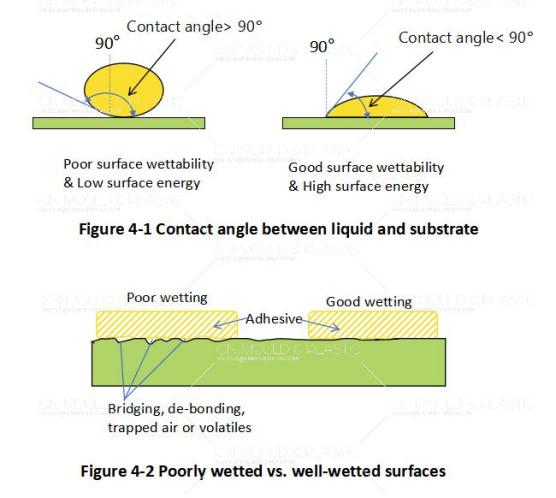
Good adhesion starts with good wetting. The contact angle between a liquid and a solid surface tells you how well the liquid spreads, as shown in the Figure 4-1. When a drop of water spreads easily on a metal surface, that surface has high surface energy. When the same drop forms a bead on polyethylene, that surface has low surface energy. Figure 4-2 illustrates the difference between these two wetting behaviors. Most plastics — especially polyolefins like PE and PP — are low‑energy surfaces. They need treatment to become bondable.
Simply put: clean the surface and raise its surface energy. These are the two goals of almost every surface treatment method.
Common Surface Treatment Methods
Cleaning and abrasion — The simplest and most common approach: wipe with solvent, abrade the surface, then wipe again with solvent. This removes contaminants and creates mechanical keying for the adhesive. Just be careful — some solvents can craze or soften the plastic.
Corona discharge — A high‑frequency electrical discharge creates plasma on the polymer surface. This introduces polar groups (like carbonyls) that raise surface energy. It is highly effective for polyolefins (PE and PP) and is widely used in film and sheet processing.
Plasma treatment — Ionized gas (such as argon) bombards the surface, cleaning it and chemically activating it. Plasma can be applied at atmospheric pressure or in a low‑pressure chamber. Depending on the gas used, it can clean, etch, or activate the surface — often increasing wettability by two to three times.
Flame treatment — A quick, controlled exposure to the oxidizing part of a gas flame melts the surface slightly and introduces polar groups. The treatment takes only seconds and is commonly used for PE, PP, and other plastics like PET, POM, and PPS.
Primers — For fluoropolymers like PTFE, etching with a sodium solution in liquid ammonia dramatically improves wettability. For polyolefins, specially formulated primers for cyanoacrylate adhesives can increase bond strength by 25 to 40 times compared to using the adhesive alone. However, these primers are specific to cyanoacrylates and are not compatible with other adhesive types.

 English
  français
  Deutsch
  Español
  italiano
  русский
  português
  العربية
  dansk
dansk  Suomi
Suomi  Svenska
  norsk
norsk