Wear is a constant challenge in mold manufacturing. To extend mold life and maintain part quality, various surface treatments are applied — ranging from hard chrome plating to nitriding and specialized coatings.
This article provides an overview of these treatments and their key considerations.
Hard Chrome Plating
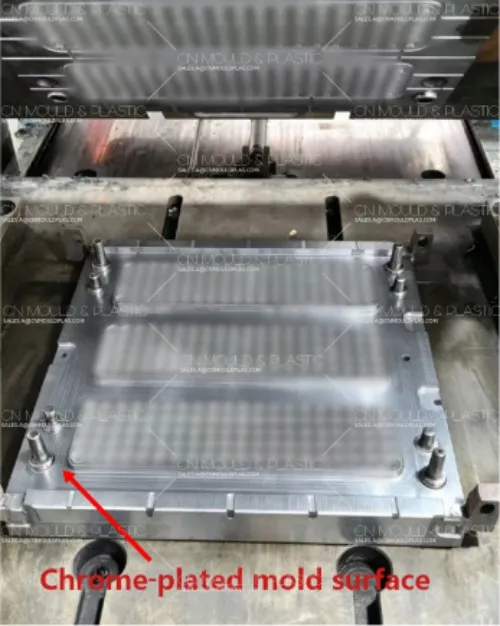
Hard chrome plating is occasionally used to increase the surface hardness of hardened steel and provide a different crystal structure that resists galling. A very thin coating, known as flash chrome (under 0.025 mm / 0.001 in), can meet certain requirements. However, chrome plating is generally not recommended as the primary method for wear reduction.
Flash chrome is sometimes applied to thin‑wall molds to improve resin flow along the cavity surface. In high‑speed, thin‑wall molding, cycle times can be reduced by as much as 0.2 seconds — potentially increasing production output by 10% or more.
Hard chrome is also commonly used when molding corrosive plastics. However, chrome is sensitive to impact. Thick deposits can crack and peel quickly, leaving a rough, abrasive surface that can damage mating mold components. Except in emergencies — such as when production must continue while replacement parts are being prepared — hard chrome is not recommended for repairing damaged surfaces.
Nitriding (Hard or Soft)
Nitriding is a surface hardening method for alloy steels. The steel is subjected to temperatures around 540°C (1000°F). Not all steels are suitable for nitriding — only those that maintain their hardness at these temperatures.
The nitrided layer is very hard, comparable in thickness to flash chrome. However, because the treatment diffuses nitrogen atoms into the steel substrate, it does not change the dimensional size of the component.
Other Coatings
Various other coatings are available for wear protection. Each has its own characteristics, and suppliers provide detailed specifications. Not all of these coatings have proven consistently successful in mold applications. The main issue is that the coating may not last as long as desired, requiring repeated re‑application.
When considering these coatings, designers and molders must distinguish between two different applications:
Cavity surface coatings – used to improve melt flow, filling, and part ejection
Sliding surface coatings – used to reduce friction between moving components
The requirements for each are different.
Common coating options include:
Poly‑Ond (nickel‑phosphorus) – Suitable for mold components up to approximately 400°C
Ovonic (Diamond Black™) – An organic coating with an application temperature of about 120°C
Low‑temperature ion nitriding – Applied at approximately 350°C
Liquid nitriding – Performed around 590°C
Titanium nitride (TiN) coatings – Applied through physical or chemical vapor deposition (PVD/CVD) at temperatures ranging from 700°C to 1065°C
Each process has its advantages and limitations. A careful investigation is required to determine whether a particular treatment is suitable for the specific material and part geometry. Detailed information should be obtained from qualified suppliers.

 English
  français
  Deutsch
  Español
  italiano
  русский
  português
  العربية
  dansk
dansk  Suomi
Suomi  Svenska
  norsk
norsk