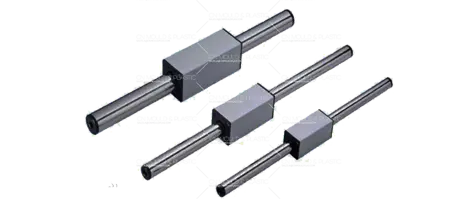
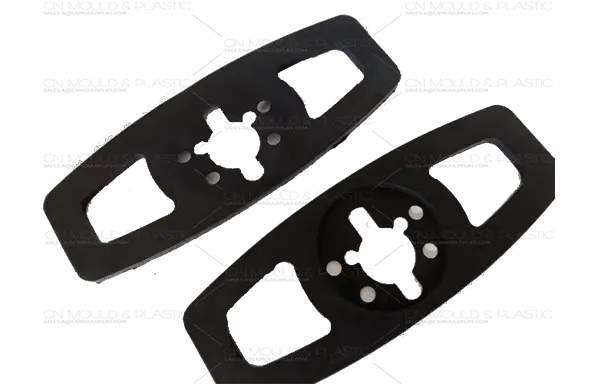
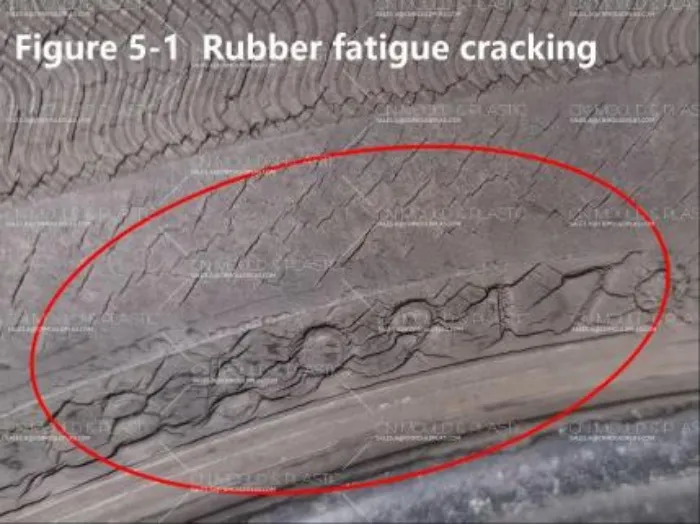
Rubber fatigue aging refers to the damage or irreversible changes in structure and properties that occur when rubber products are subjected to cyclic stress and deformation. This phenomenon is common in rolling tires, rotating conveyor belts, rubber springs, and other dynamically loaded rubber components, as shown in Figure 5-1. Fatigue aging accelerates product wear and shortens service life, making it essential to understand its causes and protection methods.
Factors Affecting Rubber Fatigue Performance
Rubber fatigue resistance is typically measured by either the number of stress (or deformation) cycles a sample can withstand before failure, or the maximum stress amplitude at failure after a predetermined number of cycles. The former is known as fatigue durability, the latter as fatigue strength.
① Stress, Strain, and Mechanical Properties
Fatigue resistance is closely related to the stress‑strain behavior and certain mechanical properties of the rubber. There is a minimum critical deformation threshold for fatigue failure in vulcanizates — for natural rubber, this threshold is approximately 70–80%. Below this level, crack growth is minimal, and fatigue durability is very high.
When deformation amplitude is fixed, increasing the rigidity of the vulcanizate increases stress, which reduces fatigue durability.
When stress is fixed, increasing rigidity reduces deformation, which improves fatigue durability.
Fatigue durability also improves with higher tensile strength and tear strength, and is proportional to elongation at break. At high stress levels, the tear strength of the vulcanizate becomes especially critical. There is a maximum critical tear energy threshold — if the tear strength exceeds this value, crack growth will not occur.
Natural rubber vulcanizates containing polysulfide cross‑links have a higher critical tear energy, while those with carbon‑carbon cross‑links have a lower critical tear energy.
② Rubber Type
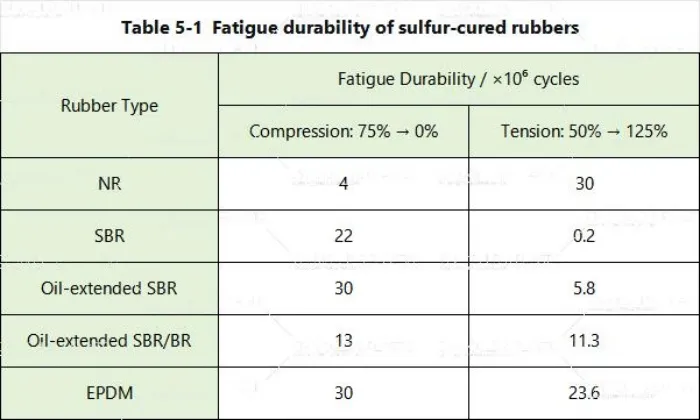
Different rubbers exhibit different fatigue durability (see Table 5-1). Under both compression and tension, fatigue durability varies significantly by rubber type. Additionally, the nature of failure differs: some rubbers develop cracks early but propagate slowly, while others develop cracks late but propagate rapidly.
The general order for crack initiation and crack growth is as follows:
Crack initiation speed: NR (Natural Rubber) > NBR (Acrylonitrile‑Butadiene Rubber) > SBR (Styrene‑Butadiene Rubber) > CR (Chloroprene Rubber) > IIR (Butyl Rubber)
Crack growth speed: SBR > NBR > CR > NR > IIR
③ Curing System
Fatigue resistance is generally best with conventional sulfur curing systems (predominantly polysulfide cross‑links), followed by semi‑efficient systems (mixed cross‑link types), and then efficient systems (predominantly mono‑ and di‑sulfide cross‑links).
Protection Against Fatigue Aging
Since rubber fatigue aging is caused by dynamic stress and strain, protection begins with compound formulation design. The vulcanizate should be formulated to maximize tensile strength, tear strength, and elongation at break while meeting overall performance requirements. This ensures higher resistance to both crack initiation and crack growth under dynamic conditions.
In addition, antioxidants should be added to inhibit flex‑cracking and crack growth. Effective flex‑cracking antioxidants include AW, RD, and BLE. p‑Phenylenediamine antioxidants — especially 4010NA and 4020 — also provide excellent protection, particularly when combined with ozone resistance.These flex‑cracking antioxidants improve the stability of structural changes during fatigue, especially at elevated temperatures. They hinder mechanically activated oxidative processes, thereby enhancing the rubber's fatigue resistance.

 English
  français
  Deutsch
  Español
  italiano
  русский
  português
  العربية
  dansk
dansk  Suomi
Suomi  Svenska
  norsk
norsk