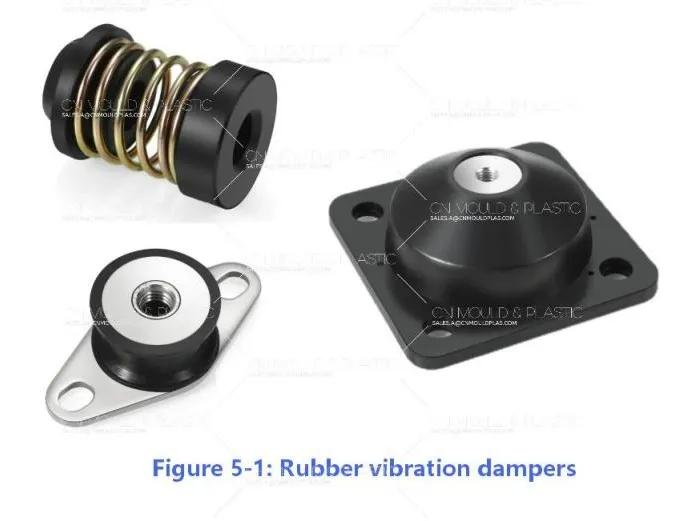
Q1: What does a rubber damper actually do?
It absorbs vibration. When a car goes over a speed bump, a washing machine spins, or a factory machine starts up — the vibration in these scenarios needs to be "eaten" by rubber parts.
But different equipment uses completely different rubber.
Q2: How do you judge a rubber's damping ability?
Look at the damping coefficient (tan δ). The higher the value, the stronger the vibration absorption.
But higher damping isn't always better. High damping means more heat generation and potentially lower fatigue resistance. So the essence of material selection is finding the balance.
Q3: Common rubbers — how do they rank by damping?
IIR (Butyl) > NBR (Nitrile) > CR (Neoprene), SBR > Silicone, EPDM, PU > NR (Natural Rubber) > BR (Butadiene)
Butyl has the highest damping. Butadiene has the lowest.
Q4: Then why is natural rubber the most widely used?
Because it has the best overall performance.
Natural rubber's damping is on the lower side, but it offers excellent fatigue resistance, low heat generation, low creep, and good bonding to metal. That's why automotive engine mounts and chassis bushings — applications requiring long life and high reliability — mostly use natural rubber.
Q5: What rubber is used for different equipment?
Equipment | Recommended Material | Reason |
Automotive engine mount | NR or NR+BR | Low damping, fatigue resistant, good metal bonding |
Washing machine damping pad | EPDM | Water resistant, weather resistant, cost-effective |
AC compressor damper | NR or CR | Heat resistant, fatigue resistant |
Precision instrument damper | Silicone | Good low-temperature dynamic performance |
High-damping applications | IIR or CIIR | Highest damping coefficient |
Q6: Once the rubber type is chosen, can production start?
No. Three more things need to be determined: curing system, filler system, and plasticizer system.
These three determine the damper's stiffness, damping, heat resistance, and service life.
Q7: How do the curing, filler, and plasticizer systems affect damping performance?
Curing system: The fewer sulfur atoms in the vulcanized network, the stronger the cross-links, the higher the elastic modulus, and the lower the damping. Heat-fatigue life ranking: Sulfur-free > EV > SEV > CV.
Filler system: The smaller the carbon black particle size and the higher the activity, the higher the damping and modulus. Natural rubber typically uses SRF and FT carbon black; synthetic rubber uses FEF and GPF carbon black. As filler content increases, damping and stiffness also increase — but so does the dependence on amplitude.
Plasticizer system: As plasticizer content increases, elastic modulus decreases, damping increases, and low-temperature performance improves. However, excessive plasticizer accelerates creep and stress relaxation, reducing long-term reliability. Polar rubbers use polar plasticizers; non-polar rubbers use non-polar plasticizers.
Summary
Rubber damper material selection comes down to one question: what does this application actually need?
Low damping, long life → Natural rubber
High damping, strong absorption → Butyl rubber
Water and weather resistant → EPDM
Low temperature → Silicone or NR+BR blend
But material choice is only the starting point. The curing, filler, and plasticizer systems determine whether the damper lasts 1 year or 10. A natural rubber damper with the wrong curing system will fail just as fast as a butyl damper with too much filler.

 English
  français
  Deutsch
  Español
  italiano
  русский
  português
  العربية
  dansk
dansk  Suomi
Suomi  Svenska
  norsk
norsk