Look at any smartwatch on the market — Apple, Samsung, Huawei, Xiaomi. Chances are, the band says "silicone."
But here's the thing: not all silicone is the same. And "silicone" isn't even the only material out there. The same label can mean very different things in cost, feel, and durability.
Today, let's compare the three most common materials — TPU, TPE, and LSR — across four things that actually matter.
The Basic Difference
TPU and TPE are thermoplastic. Heat them up, they melt. Cool them down, they solidify. It's reversible, and the scrap can be recycled.
LSR is thermoset. It cures through a chemical reaction — once it's set, it stays set. Its molecular backbone is silicone-oxygen, completely different from the carbon backbone of TPU and TPE.
1. Yellowing Resistance
This is where LSR pulls ahead.
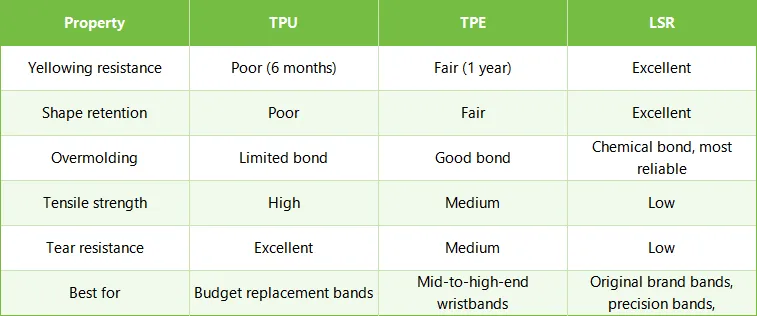
TPU has a carbon backbone that oxidizes under UV light. A clear TPU band starts turning yellow in 3 to 6 months.
TPE is a bit better — around a year before it starts to yellow.
LSR has a silicone-oxygen backbone. It resists UV, ozone, and sweat. It doesn't yellow, harden, or crack over time. That's why Apple Watch's original bands use LSR.
2. Shape Retention
You wear a smartwatch 24/7. The band stretches and compresses all day long.
TPU loses its elasticity over time — the band gets loose and sloppy.
TPE holds up better than TPU, but still not as well as LSR.
LSR has very low compression set. After months of wear, it returns to its original shape. The band doesn't stretch out.
3. Overmolding Capability
LSR can be injected directly onto plastic substrates — PC, PA, PBT — and bonds chemically. That's how smartwatch bands bond to plastic cases in a single two-shot process.
TPU and TPE can also be overmolded, but the bond strength and long-term reliability aren't as good as LSR.
4. Tensile Strength and Tear Resistance
TPU has the highest tensile strength (30–50 MPa) and excellent tear resistance. That's why cheap bands use it — it's tough and inexpensive.
TPE is medium (10–25 MPa). Softer feel, but less tear-resistant than TPU.
LSR is the lowest (5–10 MPa), and its tear resistance is on the lower side among rubbers. This is LSR's weak spot. So the buckle connection and high-stress areas need extra reinforcement in the design.
Two More Things Worth Knowing
Surface energy: LSR has very low surface energy — that's why it doesn't attract dust or feel sticky. But it also means LSR is hard to bond with other materials. It needs chemical bonding or mechanical interlocking.
Antimicrobial properties: TPU and TPE need added antimicrobial agents. LSR can be formulated with nano-silver, achieving a 99% antimicrobial rate without affecting feel or weather resistance.
Quick Comparison
So — Which Material Is Your Watch Band Made Of?

 English
  français
  Deutsch
  Español
  italiano
  русский
  português
  العربية
  dansk
dansk  Suomi
Suomi  Svenska
  norsk
norsk