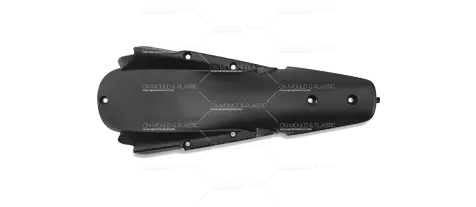
Polyphenylene sulfide (PPS) is a high‑performance engineering plastic known for its exceptional thermal stability, chemical resistance, and inherent flame retardancy. It is a precision molding material widely used in automotive, electrical, and industrial applications where reliability under extreme conditions is required.
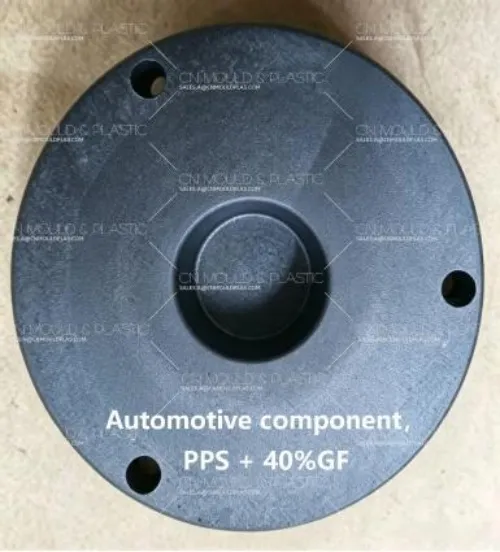
This article covers the key properties of PPS and important processing considerations for injection molding.
Key Properties
Heat resistance – PPS has a heat deflection temperature of up to 260°C (depending on grade) and a melting point of approximately 285°C. It can be used continuously at temperatures ranging from 200°C to 240°C, making it suitable for applications such as electric iron components and induction cooktop parts that must withstand high temperatures.
Flame retardancy – PPS is inherently flame‑retardant without the need for additives. It achieves UL94 V‑0 and SE‑0 ratings (no dripping) with very low smoke emission. Its oxygen index exceeds 45, meaning it will not burn in normal atmospheric conditions where oxygen content is only about 20%.
Chemical resistance – PPS offers excellent chemical resistance, second only to PTFE. It is unaffected by most organic solvents, inorganic acids, and alkalis below 200°C. It also resists automotive fluids (gasoline, oil, coolants) and electronic processing chemicals.
Mechanical properties – PPS is rigid and strong with excellent fatigue and creep resistance — properties that are well maintained at elevated temperatures. Glass fiber or carbon fiber reinforcement significantly improves mechanical strength and rigidity, while also providing excellent wear resistance and self‑lubrication.
Dimensional stability – PPS has low moisture absorption and maintains stable dimensions across a wide temperature range (‑50°C to 200°C), even in high‑humidity environments.
Electrical properties – PPS offers excellent electrical insulation and dielectric strength, with stable performance under high temperature, high humidity, and high frequency conditions.
Injection Molding Considerations
Drying – PPS requires drying at 120–140°C for 3–4 hours to improve surface quality.
Barrel temperature – Set at 290–320°C. The melt solidifies quickly, enabling short cycle times and thin‑wall molding.
Mold temperature – High mold temperature (130–160°C) is recommended to reduce internal stress and improve surface finish.
Runner and gate design – Short runners and large‑taper sprues are preferred for better flow.
Injection parameters – Use relatively high injection pressure with medium injection speed to ensure complete cavity filling.
Shrinkage – Low at approximately 0.2–0.5%, offering excellent dimensional repeatability.
Degradation risk – PPS is sensitive to thermal degradation, so process parameters must be strictly controlled.

 English
  français
  Deutsch
  Español
  italiano
  русский
  português
  العربية
  dansk
dansk  Suomi
Suomi  Svenska
  norsk
norsk