In foam processing, demand for custom-shaped seals, gaskets, and cushioning parts is growing. Traditional die cutting works well for simple shapes and high volumes — but when it comes to complex contours, frequent design changes, or small batches, it becomes costly and slow.
Here’s why it’s an effective solution for foam cutting.
1. Complex Foam Shapes Without Tooling Costs
Die cutting requires a dedicated tool for each shape — the more complex the contour, the higher the die cost. For foam parts with multiple holes, narrow slots, or irregular outlines, dies may not even be feasible.
Oscillating knife cutting is digitally driven. Complexity does not increase cost. You simply design the cutting path in software and the machine executes it — no dies, no waiting, no extra charge for complex geometry. This makes it ideal for custom foam gaskets, protective inserts, and acoustic pads with intricate internal structures.
2. Cold Cutting — No Heat Damage on Foam
Many foam materials — especially polyurethane, PE, and EVA foams — are heat‑sensitive. Laser and hot‑wire cutting can cause melting, fused edges, or surface hardening, which compromises sealing performance and appearance.
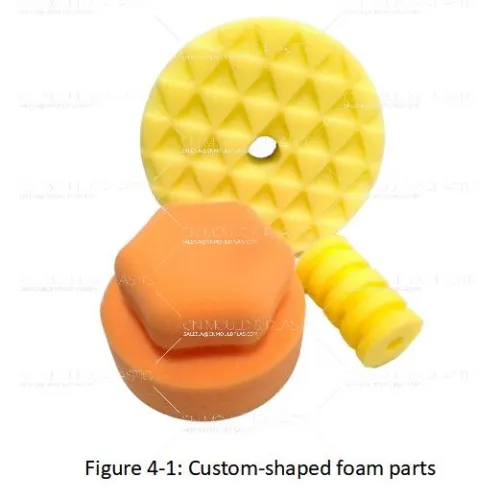
Oscillating knife cutting is a cold cutting process. No heat is generated, so the cut edges remain clean, smooth, and dimensionally accurate (see Figure 4-1) — without the hardened or melted edges that can compromise sealing performance.
3. Clean Edges — No Dust, No Debris
Traditional mechanical cutting methods like milling or routing can generate dust and loose particles — especially on open‑cell foams. These particles can contaminate adhesive layers, clog fine pores, or create messy work areas that require secondary cleaning.
Oscillating knife cutting produces clean, sealed‑like edges without generating loose particles. The high‑frequency vibration shears the foam cleanly rather than tearing or grinding it, minimizing dust, debris, and the need for post‑cut cleaning. This is particularly important for foams used in cleanroom environments or medical applications where contamination must be strictly controlled.
4. Low‑Volume and High‑Mix Foam Production
Die cutting requires a dedicated tool — costing hundreds to thousands of dollars, with lead times of several days to a week. For small foam orders, prototypes, or frequently changing designs, this is expensive and slow.
With oscillating knife cutting, no die is required. Once the CAD drawing is finalized, production can begin immediately — making it ideal for prototypes, small batches, and custom orders.

 English
  français
  Deutsch
  Español
  italiano
  русский
  português
  العربية
  dansk
dansk  Suomi
Suomi  Svenska
  norsk
norsk