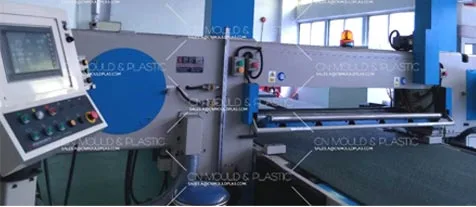
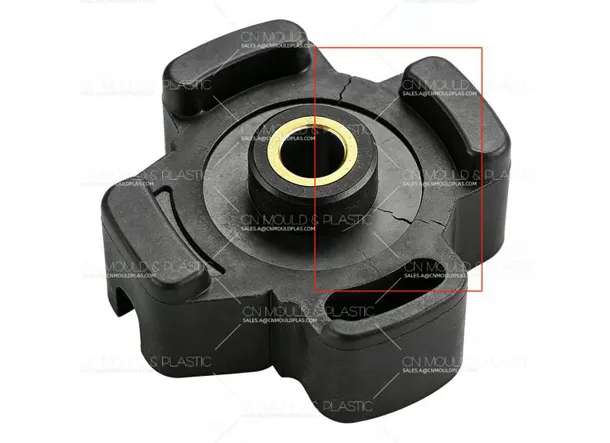
Die cutting is a process that uses a cutting die — steel blades and scoring rules embedded in a base plate — to cut or stamp material into a specific shape in one press stroke. The base plate is typically made of wood, plastic, or metal.
Common die types include:
Laser‑cut dies – The blade slots are laser‑cut into the wooden base, providing high accuracy and fast turnaround.
Engraved dies – CNC‑engraved as a single piece, suitable for small batches or complex shapes.
Chemically etched dies – The blade and base are formed as one piece through chemical etching, offering high precision for delicate electronic components.
The key advantage of die cutting is one‑step forming — it is fast and efficient. Cutting accuracy depends on both the die quality and the material being cut. For soft materials such as foam, the die compresses the material before cutting. If the die is not properly designed, the cut surface may have slight concavity or slant.
Where Die Cutting Fits in Injection Molding
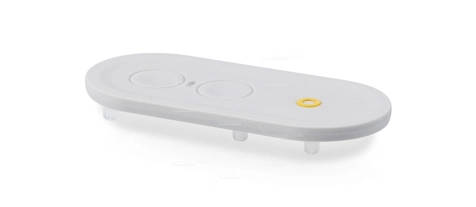
Foam seals and gaskets – In injection molded housings, foam gaskets are widely used between enclosure panels to provide sealing and cushioning. These gaskets can be custom‑cut to match flat sealing surfaces without the need for complex sealing channels in the plastic part.
Adhesive tapes and mounting films – Die‑cut adhesive tapes and foam tapes are used to bond injection molded parts to other components. The backing material — often PET — ensures dimensional stability during cutting, and many tapes come with pre‑applied adhesive layers to reduce assembly steps.
Precision electronic components – In smartphones and tablets, die‑cut parts such as conductive foam, EMI shielding, insulating materials, and protective films are essential. Etched dies can achieve cutting accuracies of 0.03–0.05 mm, meeting the tight tolerances required for micro‑level electronic applications.
Other foam and rubber parts – EVA, silicone foam, and microcellular polyurethane are also die‑cut into seals, cushioning pads, acoustic guides, and gap fillers.
Limitations and Alternatives
Upfront tooling cost – A dedicated die is required for each part, so unit cost decreases with higher production volume.
Slow changeover – Switching to a different part requires a new die, making it less suitable for projects with frequent design changes.
Flat‑cut only – Die cutting is essentially a flat stamping process and cannot produce curved or 3D contoured shapes.
Soft material deformation – When cutting soft materials like foam, the cut edge may show slight concavity or slant.
For small batches, complex shapes, or frequent design changes, CNC cutting or laser cutting may be more suitable. For high‑volume, stable‑shape, long‑run orders, die cutting remains the most cost‑effective option.

 English
  français
  Deutsch
  Español
  italiano
  русский
  português
  العربية
  dansk
dansk  Suomi
Suomi  Svenska
  norsk
norsk