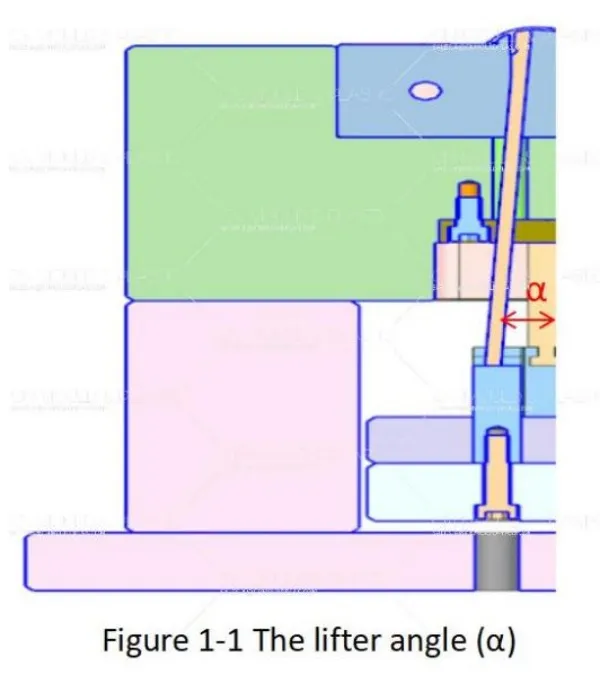
You picked a lifter angle (see Figure 1-1). Maybe you copied it from the last design. Maybe you just guessed.
Three weeks later, the mold is sticking. The rod is bending. Or it’s jammed so bad you‘re pulling the whole tool off the press.
Most lifter failures aren’t a steel problem. They‘re an angle problem. And 80% of them happen because the designer picked a number without understanding the trade‑off.
The lifter angle (α) controls three things:
How smooth the slide moves
How much stress goes through the rod
How far it can pull the core
Get it right, and the mold runs reliably for millions of cycles. Get it wrong, and you’ll be reworking the mold within weeks — delayed deliveries, extra costs, and a very unhappy customer.
Here‘s what works, what doesn’t, and why.
The Trade‑Off: Smooth Sliding vs. Core‑Pull Stroke
A smaller lifter angle reduces friction and bending force on the lifter rod — the lifter slides more smoothly and experiences less stress. However, a smaller angle also reduces the core‑pull stroke for a given ejection distance.
The angle also affects the space required for the lifter mechanism. If the angle is not properly matched to the available space, the lifter may interfere with other components — causing the lifter rods to collide with each other, or the bottom of the lifter to extend beyond the ejector plate.
Recommended Lifter Angle Ranges
3°–5° – Smooth Sliding – Choose this range whenever the core‑pull stroke allows it, especially when the lifter rod is thin or narrow. Reducing the angle compensates for the rod‘s lower bending strength.
5°–9° – The Sweet Spot – This is the most widely used range in production. It offers a practical balance of stroke, sliding stability, and reliability.
9°–12° – Use with Caution – Friction and bending forces increase significantly. Only use if your product absolutely requires it.
>12° – The Danger Zone – The risk of mold jamming increases dramatically. Never exceed 16° — beyond that, the mechanism becomes highly unreliable.
What This Means for Your Project
If your mold designer picks an angle above 9° without a good reason, ask why. It could mean shorter mold life, higher maintenance costs, and delayed deliveries. A small change in the design phase saves big headaches later.

 English
  français
  Deutsch
  Español
  italiano
  русский
  português
  العربية
  dansk
dansk  Suomi
Suomi  Svenska
  norsk
norsk