Heat treatment is one of the most critical steps in mold manufacturing. Get the sequence wrong, and the mold cracks. Get the process wrong, and the part breaks in service.
Here are two common heat treatment mistakes we see in mold making — and how to avoid them.
Mistake 1: Wrong Process Sequence
The order of heat treatment operations directly affects the final properties of the mold component.
Before machining – Annealing and normalizing improve machinability and prepare the microstructure. They should be done before or during early machining, never after finishing.
Between rough and semi‑finish machining – Quenching and tempering (through hardening) should be done here for parts that require minimal distortion during hardening or will be nitrided later. Typical sequence: rough machine → quench and temper → semi‑finish. This prepares a fine, uniform microstructure at 24–35 HRC.
Also between rough and semi‑finish machining – Aging (stress relief) removes internal stresses from casting, forging, or heavy machining. For complex or high‑precision parts, add a second aging step here. For very high‑precision parts, schedule multiple aging steps.
Between semi‑finish and finishing – Hardening (quenching, carburizing, etc.) goes here. The part should be close to final shape but still have enough stock for final grinding.
After finishing, before final grinding – Nitriding is a low‑temperature surface hardening process that causes minimal distortion. It should be scheduled after finish machining and after mold trial. For extremely tight tolerances, place nitriding before final grinding and mold trial.
Case example – Grinding spindle
Wrong sequence: Forging → Annealing → Rough turning → Rough grinding → Nitriding → Finish grinding
Correct sequence: Forging → Annealing → Rough turning → Quench and temper (to fine sorbite, 24–35 HRC) → Finish turning with stabilization temper → Rough grinding → Nitriding → Finish grinding
The principle: Nitriding should be one of the last operations — after rough grinding, before finish grinding. This preserves the hardened surface while achieving final dimensional accuracy.
Mistake 2: Hardening the Entire Part When Only the Surface Needs It
If surface hardening meets the service requirements, do not harden the entire part, as shown in Figure 3-1.
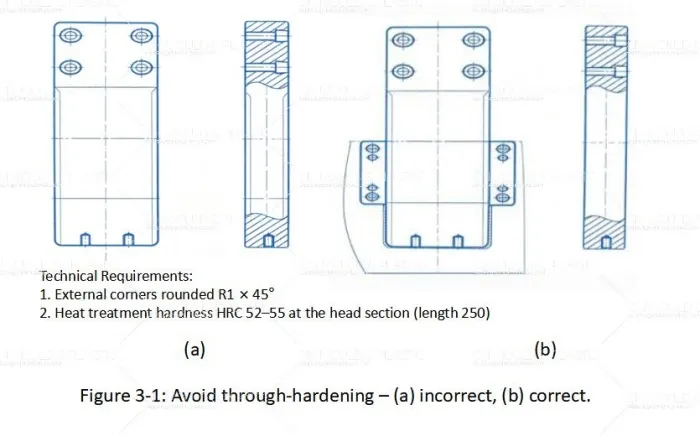
Through‑hardening a part that only needs surface wear resistance makes it brittle and prone to fracture under impact or bending loads. The correct approach is to harden only the functional portion — keeping the rest tough and ductile to absorb shock without breaking.
The principle: Hardening increases wear resistance but reduces toughness. If a part only needs wear resistance on a specific surface, harden only that surface. Keep the rest tough enough to handle mechanical loads.

 English
  français
  Deutsch
  Español
  italiano
  русский
  português
  العربية
  dansk
dansk  Suomi
Suomi  Svenska
  norsk
norsk