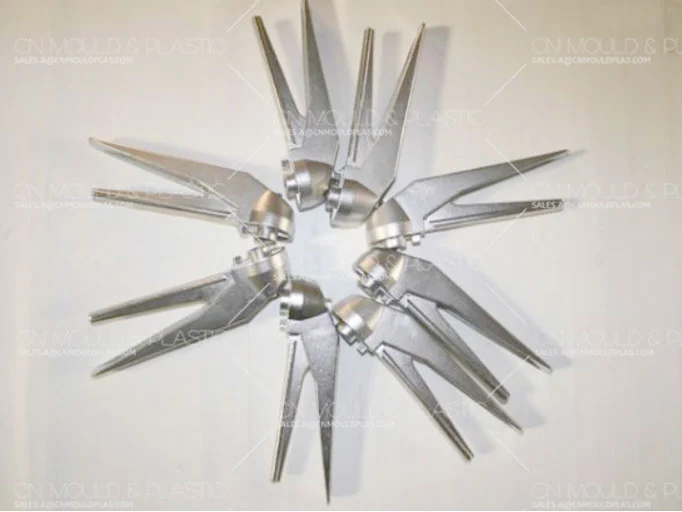
You‘ve just finished a new mold. It looks perfect. Then it comes back from heat treatment with a crack. Or soft spots. Or it’s warped and won‘t fit the press.
Now you’re looking at days of rework — or a complete remake.
Heat treatment problems don‘t just cost time. They cost money. And most of them are preventable.
Here’s what goes wrong — and how to stop it before it happens.
Quenching Cracks (see Figure 3-1)
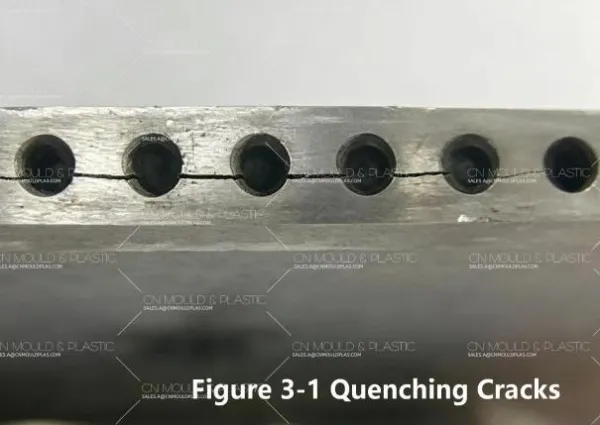
Why it happens: Thermal stress from rapid cooling meets transformation stress from uneven martensite formation. Sharp corners, EDM white layer, and coarse machining marks act as starting points. Decarburization and excessive grain growth make it worse.
How to prevent it: Add radii to sharp corners, improve surface finish, control heating atmosphere, and use proper quenching parameters. Vacuum or controlled‑atmosphere heating reduces crack risk.
Insufficient Hardness
Why it happens: Quenching temperature too low leaves soft structures; too high increases retained austenite. Slow cooling causes incomplete hardening. Decarburizing atmosphere lowers surface carbon.
How to prevent it: Verify actual quenching temperature, use sufficient cooling rate for the steel grade, control furnace atmosphere, and adjust tempering temperature and duration.
Dimensional Deformation
Why it happens: Residual stresses from machining release during heating. Uneven heating/cooling and improper furnace loading cause warpage. Large wall thickness differences create differential cooling rates.
How to prevent it: Perform stress‑relief annealing before quenching, use proper fixturing, heat slowly and evenly, and use step quenching to reduce temperature differences.
Oxidation and Decarburization
Why it happens: Surface reacts with oxygen to form scale, or carbon diffuses outward faster than oxidation, depleting surface carbon.
How to prevent it: Use vacuum or protective atmospheres. Control furnace atmosphere precisely. Remove any scale before quenching.
What‘s the most common heat treatment issue you’ve encountered in your molds?

 English
  français
  Deutsch
  Español
  italiano
  русский
  português
  العربية
  dansk
dansk  Suomi
Suomi  Svenska
  norsk
norsk