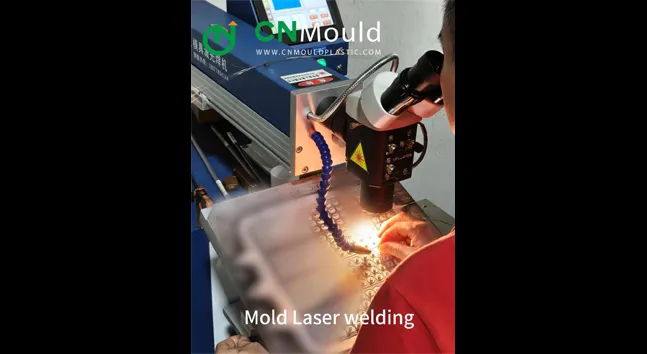
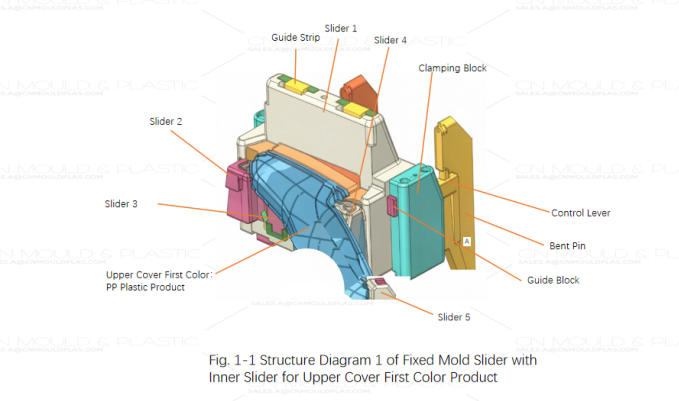
In the world of injection molding, complex part geometries often require equally complex mold designs. One such example is the first-color top cover shown in Figure 1-1, which features an innovative stationary mold slider combined with internal sliders. This blog post breaks down how this mechanism works during the mold opening process to achieve successful ejection of the first-color PP component.
The Initial Setup
As shown in Figure 1-1, the press block is fixed to the moving mold base, while all other components are mounted on the stationary mold side. Once the first-color PP material is injected and the molding cycle begins, the action kicks off during mold opening.
Step 1: Initial Movement and Guiding
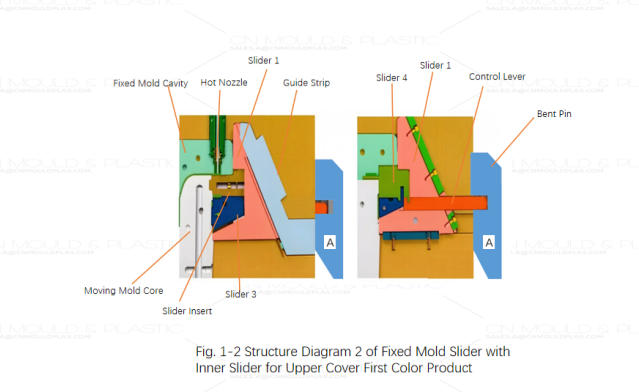
When the mold starts to open, the press block—attached to the moving mold—drives the guiding block. This movement causes Slider 1 to travel along the guide rails (see Figure 1-2). Simultaneously, under the influence of the bent pin (cam pin) and control rod, Inner Slider 2, Inner Slider 3, and Inner Slider 4 begin their motion along their respective T-shaped guide blocks.
Step 2: Reaching Position A
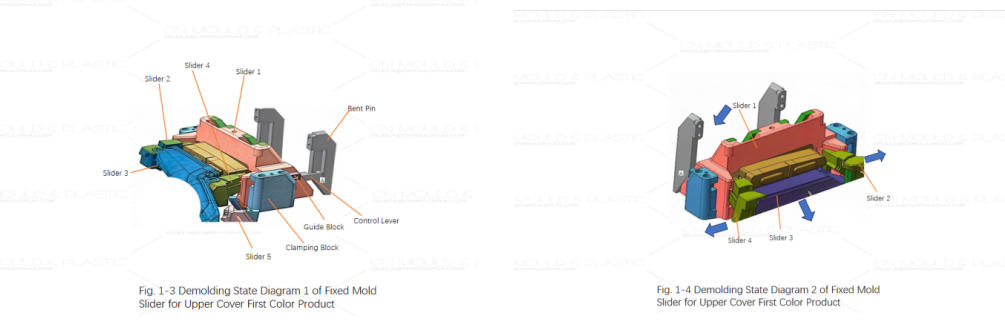
As the control rod reaches Position A of the bent pin (see Figures 1-3 and 1-4), Inner Sliders 2, 3, and 4 complete their part of the ejection process for the first-color product. At this point:
These three inner sliders have finished their core-pulling actions.
Slider 1, however, continues its motion along the T-shaped guide block to continue the ejection of the first-color part.
Step 3: Completion of Ejection for Slider 1
As the mold continues to open, the control rod no longer influences Inner Sliders 2, 3, and 4. From this point onward, these inner sliders move in sync with Slider 1.
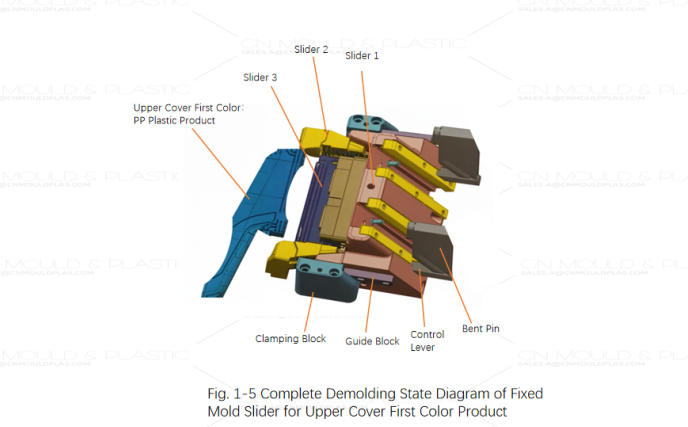
When the control rod reaches Position B of the bent pin (see Figure 1-5), Slider 1 also completes its full ejection and core-pulling action for the first-color product. At this stage:
The press block disengages from the guiding block.
The slider assembly remains on the stationary mold side.
Final State
With the first mold opening sequence now complete, all stationary mold sliders and inner sliders have successfully finished the ejection process for the first-color part, as illustrated in Figure 1-5.

 English
  français
  Deutsch
  Español
  italiano
  русский
  português
  العربية
  dansk
dansk  Suomi
Suomi  Svenska
  norsk
norsk