You pull a textured part out of the mold — and it‘s scratched. Or it sticks. Or it drags on the way out.
You check the material. You check the texture. Everything looks fine.
The problem is often simpler than you think: the draft angle was designed for a polished surface, not for the actual cavity finish.
When you design a textured surface with the same draft angle you’d use for a smooth surface, you‘re building in ejection problems from the start.
The Basic Rule
Smoother surfaces need less draft. Rougher surfaces need more.
Surface texture creates friction. When a part ejects, it slides against the cavity wall. A smooth wall releases cleanly. A rough wall drags — and the texture gets scratched or scuffed in the process.
Three Factors That Determine Draft Angle
1. Material Shrinkage
Higher shrinkage means the part shrinks tighter onto the core after cooling. That increases friction during ejection, so you need more draft.
Material | Recommended Draft Angle |
PP, PE | 0.5° ~ 1° |
PA, ABS, POM | 1° ~ 1.5° |
PC, PS, PMMA | 1° ~ 2° |
If your material shrinks a lot, start with a larger draft angle.
2. Surface Texture
Texture creates peaks and valleys on the cavity surface. Those peaks act like tiny hooks — they grab the part as it tries to slide out. The deeper the texture, the more friction.
A good rule of thumb: each 0.025 mm of texture depth needs about 1°–1.5° of draft angle.
For example, a standard leather‑grain texture (around 0.1 mm deep) typically needs 5°–8° of draft — which is significantly more than the 1°–2° you‘d use for a polished part.
Quick reference by texture type:
Texture Type | Minimum Draft Angle |
Fine matte | 1° ~ 2° |
Medium texture | 2° ~ 3° |
Coarse texture | 3° ~ 5° |
Leather grain / deep texture | 5° ~ 10° |
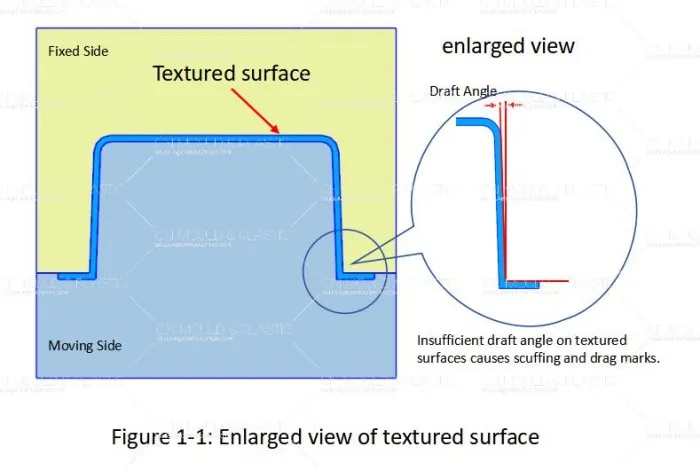
If the draft angle is too small for a textured surface, the part will scuff or drag during ejection (see Figure 1-1). The damage is usually permanent — and the mold has to be modified.
3. Part Height
Draft angle creates a thickness variation — the part is thicker at the base and thinner at the top. The taller the part, the more that variation adds up.
If you use too much draft on a tall part, the top wall might end up too thin — out of tolerance, and out of spec.
So for shallow parts, you can use a bit more draft to make ejection easier. For tall, deep parts, you need to keep the draft angle small to maintain wall thickness consistency.
It’s a balancing act: enough draft to release, but not so much that you lose the dimension.

 English
  français
  Deutsch
  Español
  italiano
  русский
  português
  العربية
  dansk
dansk  Suomi
Suomi  Svenska
  norsk
norsk