When we talk about the appearance of a plastic part, we mean things like its shape, color, gloss, and surface quality — basically, everything you can see and feel with your eyes.
Different parts have different appearance standards depending on their size and what they will be used for. However, one thing should always be the same: the lighting used during inspection.
There is also a big difference between visible areas (surfaces that can be seen after assembly) and hidden areas (inside surfaces or parts that are covered up).
Below are the general visual inspection standards for molded parts:
(1) Weld Lines
How visible a weld line is depends on its depth, length, number, and location. Depth matters the most. As a quick test, run your fingernail across the line — if you can't feel it, the part is usually acceptable. Compare the part to a sample to make a final judgment.
(2) Sink Marks
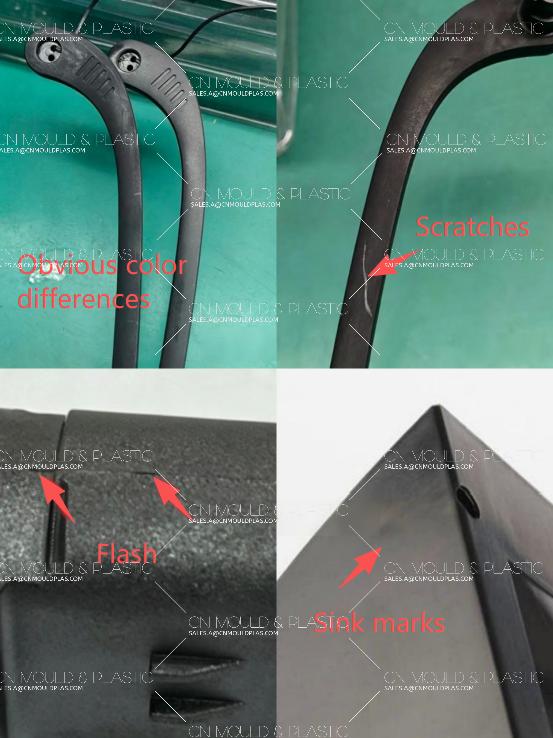
If you tilt the part at an angle, sink marks become easier to see. But in normal inspection, you just look straight at the part and decide if the sink mark is too severe.
(3) Flow Marks
Flow marks are not allowed on the front face or the highest raised areas of the part. For other areas, the acceptability of flow marks is judged by comparison with a sample.
(4) Silver Streaks (Gas Marks)
These are hard to see on white parts but become more obvious on darker colors. Even if they don't ruin the look of a white part, silver streaks can cause paint or hot stamping foil to peel off later. So, if a part will be painted or hot stamped, silver streaks are not allowed.
(5) Whitening
Whitening happens when a part is stressed too much in one spot (for example, where it is pushed out of the mold). Whitening not only looks bad but also weakens the part.
(6) Cracks
Cracks are not only an appearance defect but also a weakness in part strength. Therefore, cracks are not allowed on any part. They often occur around gates, sharp corners, and edges — these areas should be inspected closely.
(7) Contamination (Dirt or Specks)
For transparent or light‑colored parts, the allowable size and number of contaminant particles must be clearly defined for each surface. For example, up to five particles of diameter 0.5 mm or less may be allowed on a side surface, provided the distance between any two particles is no less than 50 mm.
(8) Color
Parts should be inspected against a color swatch or reference sample. Obvious color differences or uneven color distribution are not acceptable.
(9) Gloss
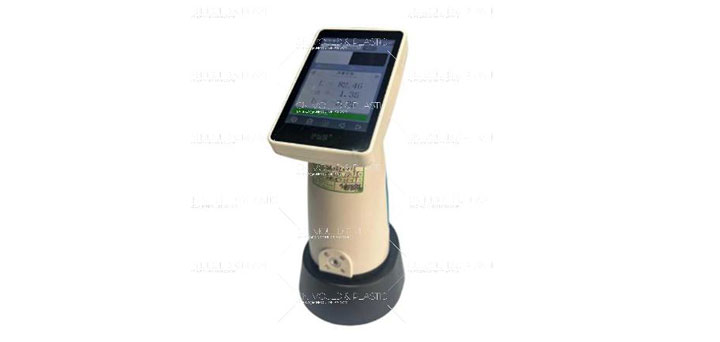
Gloss is checked by comparing the part to a gloss or roughness standard. For high-value parts like plastic enclosures, the front surface and highest raised areas need strict gloss control. (See standard GB/T 8807-88 for the official test method.)
(10) Transparency (Refractive Index)
Cloudiness is the biggest problem for transparent parts. Transparency is checked by measuring how much light passes through, usually by comparing to a standard sample. (See standard GB 2410-80 for more details.)
(11) Scratches
Parts can get scratched when they are moved, processed, or stored after molding. Parts with steps or sharp edges are especially easy to scratch. If a scratch is on the front or a raised area, the part is rejected. For other areas, follow the agreed rules.
(12) Gate Trimming Marks
Gate trimming marks should be inspected using a ruler or other measuring tool.
(13) Flash
Flash is not allowed on any part. If a part has flash, it must be trimmed off with a knife. Compare the trimmed part to a sample. If flash suddenly appears on a surface that normally has none, stop production and find the cause immediately.
(14) Text and Symbols
Text and symbols on the part must be clear and legible. If they are worn, damaged, or blurred, not only does the appearance suffer, but important functional information may be lost, affecting usability.

 English
  français
  Deutsch
  Español
  italiano
  русский
  português
  العربية
  dansk
dansk  Suomi
Suomi  Svenska
  norsk
norsk