Coloring refers to adding colorants to plastic materials. Mixing is the process of evenly distributing them.
Direct Coloring with Pigments
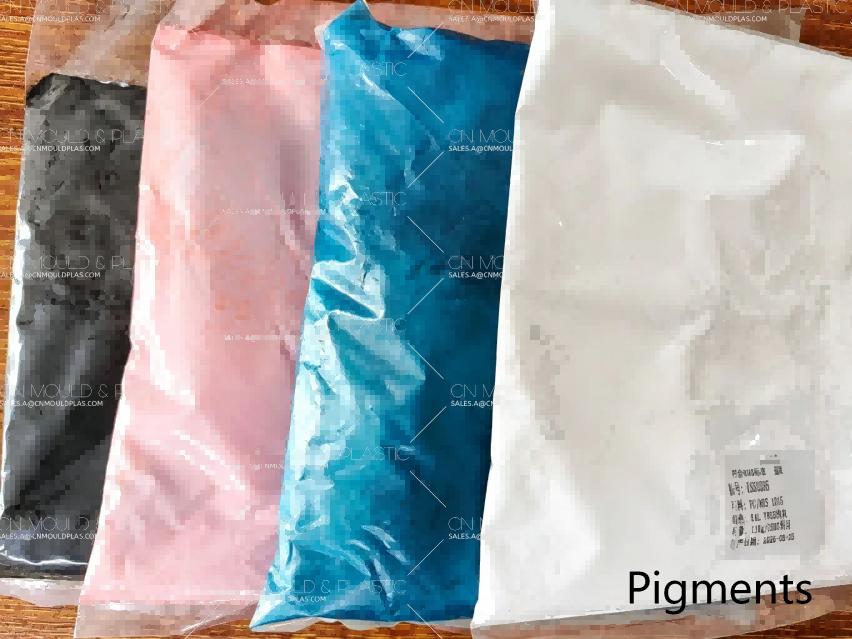
Directly mixing pigments with plastic is a traditional method with relatively low material cost. It is suitable for applications with low color requirements, long production runs, and tight profit margins.
In this process, plastic pellets, a measured amount of pigment, and a small quantity of white oil (mineral oil) are placed into a rotary mixer. The white oil acts as a wetting agent, helping the pigment adhere to the surface of the plastic pellets. After sufficient mixing, the pigment is uniformly distributed on the pellet surfaces.
Key Selection Criteria for Colorants
When selecting a colorant for plastic injection molding, the following factors should be considered.
Bright and vivid color with strong coloring power
Good dispersibility in the plastic matrix
Good heat resistance (no decomposition or color change during processing)
Good weather resistance (resists discoloration from light and heat)
Good solvent resistance and chemical stability
No adverse effects on processing or performance
Low toxicity, odorless, and reasonably priced
Material Mixing
Mixing is the process of adding all required raw materials and auxiliaries into a mixer and rotating them for a set time until the components are evenly distributed. Mixing operations generally include the following:
Blending different types or grades of plastics
Mixing color masterbatch or functional masterbatch with plastic
Blending various additives with powdered plastic
Blending various additives with granular plastic
For injection molding, mixing is typically performed using a standard mixer or a high‑speed stirrer.
A standard mixer has a simple structure and is easy to operate. The mixing vessel is a rotating drum equipped with a spiral stirring blade. As the drum rotates, the materials are continuously stirred and blended evenly.
A high‑speed stirrer uses a rapidly rotating impeller to generate high‑speed movement of the materials. This not only achieves uniform dispersion but also generates frictional heat, which raises the temperature of the materials. This heat helps remove moisture and low-molecular-weight volatiles during mixing. However, because the temperature of the plastic increases with mixing time and may eventually melt, care must be taken to control the mixing duration.
Summary
In short, coloring defines the color, while mixing ensures it is uniform. Both are essential for producing high-quality, consistent plastic parts. Understanding the characteristics of each method helps you choose the right approach for your application.

 English
  français
  Deutsch
  Español
  italiano
  русский
  português
  العربية
  dansk
dansk  Suomi
Suomi  Svenska
  norsk
norsk