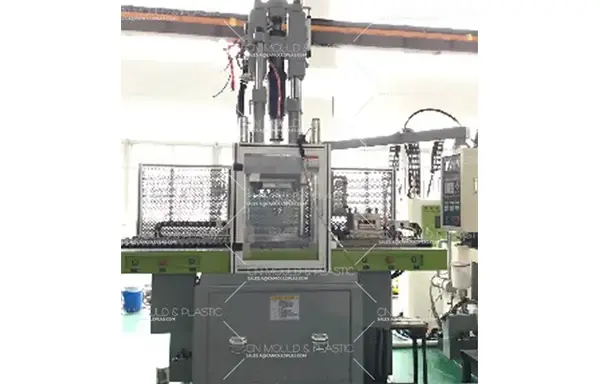
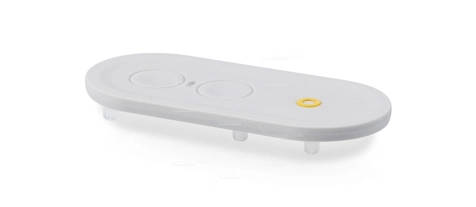
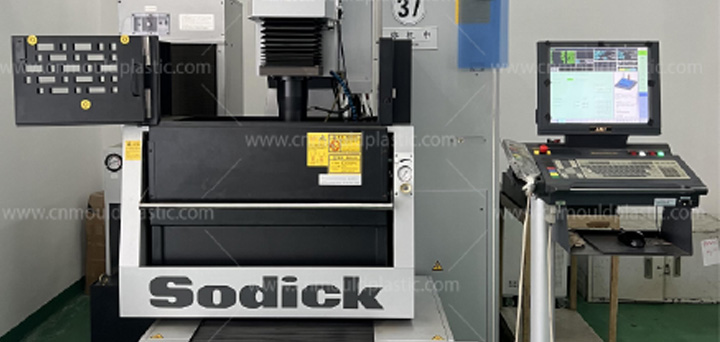
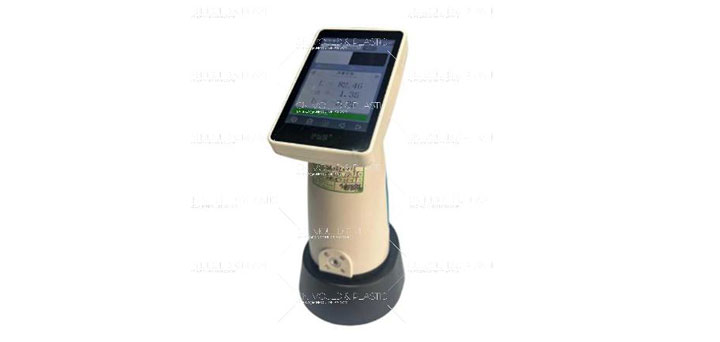
Polyamide (PA) plastics — commonly known as nylon — are widely used in injection molding. Proper process control is essential to achieve high‑quality parts. Key parameters include barrel temperature, mold temperature, injection pressure, and injection speed. These variables depend on the resin grade, part geometry, mold design, and equipment.
Barrel Temperature
Different PA grades have different melting points. As a general rule, the barrel temperature should be set 10–30°C above the melting point of the specific resin. For example, PA6 melts at 215°C and is typically processed at 225–245°C, while PA66 melts at 250–260°C and requires 260–290°C. PA11 has a lower melting point of 180°C, with a processing range of 190–210°C. PA610 and PA1010 fall between these ranges.
PA is prone to oxidation at high temperatures. Therefore, the barrel temperature should not be set too high, and the melt residence time should be kept under 30 minutes. Longer residence times may cause discoloration.
Mold Temperature
Mold temperature affects crystallinity, mechanical properties, and part appearance. Higher mold temperatures produce higher crystallinity, greater hardness, and better mechanical properties. Lower mold temperatures result in lower crystallinity, better toughness and transparency, but may cause uneven cooling in thick parts, leading to voids.
For thin‑wall or complex parts, a higher mold temperature is recommended to prevent premature solidification. For very thick parts, a higher mold temperature also helps avoid bubbles and sink marks while reducing internal stress from packing. The typical mold temperature range for PA is 40–90°C, depending on the grade and part requirements.
Injection Pressure and Holding Pressure
Injection pressure for PA is typically in the range of 68–100 MPa, though some grades like PA66 may require up to 130 MPa. Higher pressure reduces shrinkage but may cause flash. Lower pressure may lead to sink marks, flow marks, or short shots.
Holding pressure should be kept as low as possible — just high enough to prevent voids and sink marks — to avoid increasing internal stress in the part.
Injection Speed
PA generally requires a slightly fast injection speed to prevent flow marks and filling problems caused by rapid cooling. However, too high a speed can trap air and create bubbles or cause flash. Therefore, slow injection speed is recommended when mold venting is poor, flash is a concern, or the part has thick walls.
Process Summary by Grade
PA6 requires vacuum drying at approximately 105°C for about 8 hours. The barrel temperature should be 230–260°C (250–280°C for glass‑fiber‑reinforced grades). Mold temperature should be 80–90°C for structural or thin‑wall parts to improve strength and stiffness, but below 40°C for parts thicker than 3 mm. Injection pressure is 68–100 MPa, cooling time is 20–40 seconds, and shrinkage is 1.0–1.5% — reduced to about 0.3% with glass fiber reinforcement.
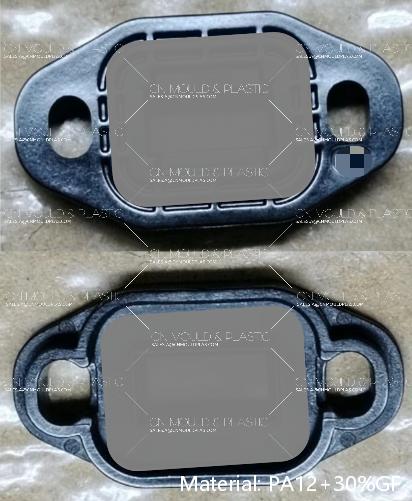
PA12 requires drying at 85–105°C for 8–12 hours, with moisture content below 0.1%. The barrel temperature should be 240–280°C (flame‑retardant grades should not exceed 270°C). Mold temperature is 40–60°C for unreinforced grades, 80–90°C for thin‑wall or large parts, and 90–100°C for reinforced grades. High injection speed is generally recommended, with injection pressure of 60–100 MPa.
PA66 requires vacuum drying at 90–110°C for 8–12 hours, with moisture content below 0.1%. The barrel temperature should be 260–290°C (275–280°C for glass‑fiber‑reinforced grades, never exceeding 300°C). Mold temperature is approximately 80°C, injection pressure is 80–130 MPa, and cooling time is 20–40 seconds.

 English
  français
  Deutsch
  Español
  italiano
  русский
  português
  العربية
  dansk
dansk  Suomi
Suomi  Svenska
  norsk
norsk