A safety visor is simple. It protects the face. It lets you see.
But pick the wrong material, and it cracks on impact. Or it’s too heavy. Or it’s clear enough to see through, but not strong enough to stop a flying object.
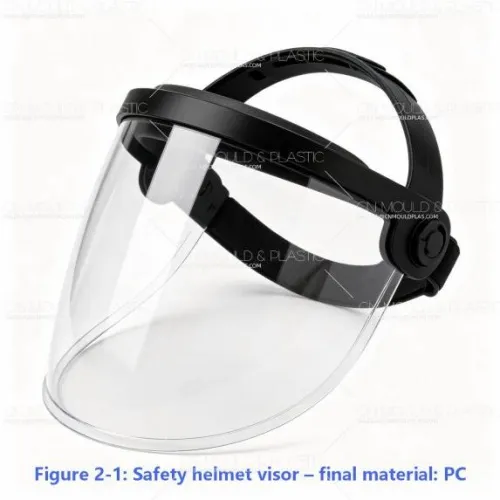
We recently worked on a safety helmet visor project. The requirements were straightforward: transparent, easy to mold, and as shatter‑resistant as possible.
Here’s how we found the material that checked every box.
The Must‑Haves
Three non‑negotiable requirements:
Transparency – The wearer needs to see clearly. No haze, no distortion.
Moldability – It has to flow well in a mold. If it’s hard to process, it’s not practical.
Impact resistance – This is a safety product. If it shatters, it fails.
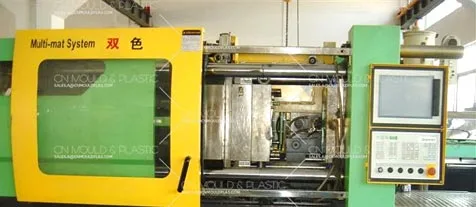
We also knew injection molding was the right process for this part. It handles high volumes, holds tight tolerances, and works well with transparent plastics. Surface treatments like coatings or polishing could add scratch resistance, but the material itself had to do the heavy lifting.
Six Candidates, One Winner
We started with six materials that met the basic requirements:
PC (Polycarbonate) – Clear, strong, impact‑resistant. The industry standard for safety visors.
PS (Polystyrene) – Clear and easy to process, but less tough. Good for low‑cost applications.
PMMA (Acrylic) – Excellent clarity and weatherability. Often used for transparent panels, but less impact‑resistant than PC.
CA (Cellulose Acetate) – Good clarity and surface finish. Low stress cracking risk. Common in eyewear.
Specialty Glass – Very clear and scratch‑resistant. But heavy and hard to shape.
PUR (Polyurethane) – Tough and transparent, but less common for visors due to processing challenges.
We filtered the list by two hard constraints — transparency and moldability. Then we ranked the remaining candidates by fracture toughness. Because for a visor, impact resistance is what really matters.
The Top Three and the Final Pick
Three materials stood out: PC, CA, and PMMA. All met the basic requirements. The question was: which one gives you the most toughness for the cost?
We calculated fracture toughness per unit cost — how much impact resistance you get for every dollar spent.
PC came out on top. It delivered the best balance of clarity, moldability, and impact resistance at a reasonable cost. CA and PMMA were close, but PC consistently outperformed them in shatter resistance.
So PC was the final pick — the one that checked every box and still made sense for production.
What This Means for You
This is the kind of decision we make every day. Material selection isn’t about picking the strongest or the clearest. It’s about finding the best fit for your application — one that meets the requirements, performs well, and fits your budget.

 English
  français
  Deutsch
  Español
  italiano
  русский
  português
  العربية
  dansk
dansk  Suomi
Suomi  Svenska
  norsk
norsk