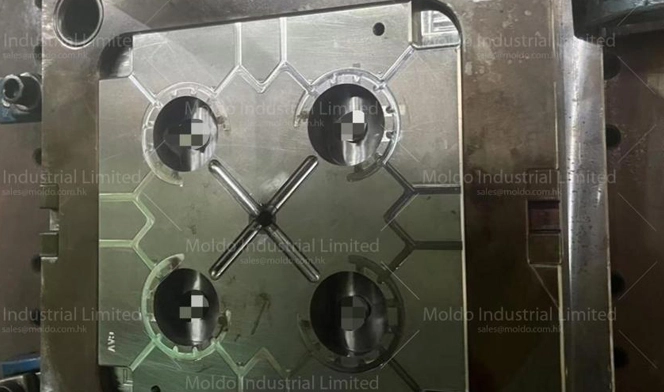
Wire Electrical Discharge Machining (Wire EDM) uses a moving conductive wire as an electrode to cut workpieces through spark erosion. Because this method is not limited by material hardness—it can machine high-hardness cavities even after quenching—and especially with CNC control, it achieves highly accurate cutting paths. As a result, Wire EDM has become a fundamental method for hole and cavity machining.
What are its key features?
① As a subtype of EDM, its machinability is similar to other EDM processes. It can cut any electrically conductive material, including cemented carbide.
② The surface microstructure and subsurface characteristics it produces differ from conventional machining, but each has its own suitable applications.
③ It uses water or water-based dielectric fluids, which are non-flammable, making unattended operation safer and easier to achieve.
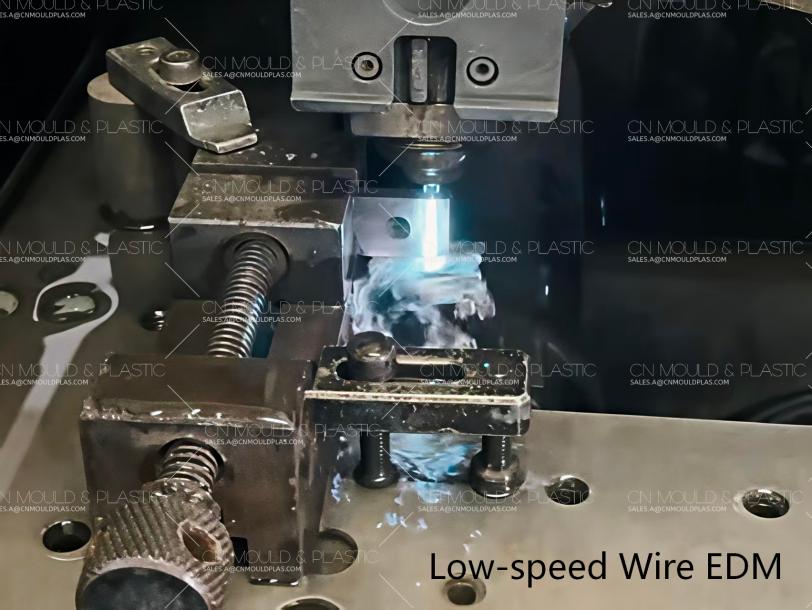
④ Stable arc discharge is generally absent. Because the wire and workpiece are in continuous relative motion, the gap conditions mainly consist of normal spark discharge, open circuit, and short circuit. Multiple discharge states may occur within a single pulse, including phenomena like "micro-open" and "micro-short" circuits.
⑤ There is a "loose-contact" light-pressure discharge phenomenon. When the wire approaches the workpiece within the typical discharge gap (e.g., 8–10 µm), spark discharge does not occur immediately. Normal spark discharge only happens when the workpiece pushes the wire sideways, creating a slight deflection (a few to tens of micrometers). Macroscopically, discharge takes place under a light contact pressure.
⑥ It eliminates the need for a shaped electrode, significantly reducing design and manufacturing costs for electrodes, shortening lead times and production cycles. This is especially valuable in mold manufacturing.
⑦ The electrode wire is very fine, allowing machining of micro-sized irregular holes, narrow slots, and complex shapes. The narrow kerf means minimal material removal, high material utilization, and significant savings when machining precious metals.
⑧ The use of a long, continuously moving wire results in low electrode wear per unit length, minimizing its impact on machining accuracy. Particularly in low-speed wire EDM (LS-WEDM), the wire is used only once, so electrode wear has an even smaller effect on precision.
Main application areas
①Stamping die machining
With a single CNC program and adjustable offset compensation, Wire EDM can machine punches, punch plates, dies, stripper plates, and even tapered dies for extrusion, powder metal, bending, and plastic molding applications.
②EDM electrode machining
Wire EDM is especially economical for materials like copper-tungsten and silver-tungsten alloys, and is ideal for producing micro or complex-shaped electrodes.
③ Direct part machining
Ideal for new product prototyping and small-batch, high-mix production. It can cut parts directly from sheet metal — such as motor laminations — without the need for dedicated molds. Design changes are easy, and thin parts can be stacked for simultaneous cutting. Also suitable for cams, templates, form tools, irregular slots, and micro-features.

 English
  français
  Deutsch
  Español
  italiano
  русский
  português
  العربية
  dansk
dansk  Suomi
Suomi  Svenska
  norsk
norsk