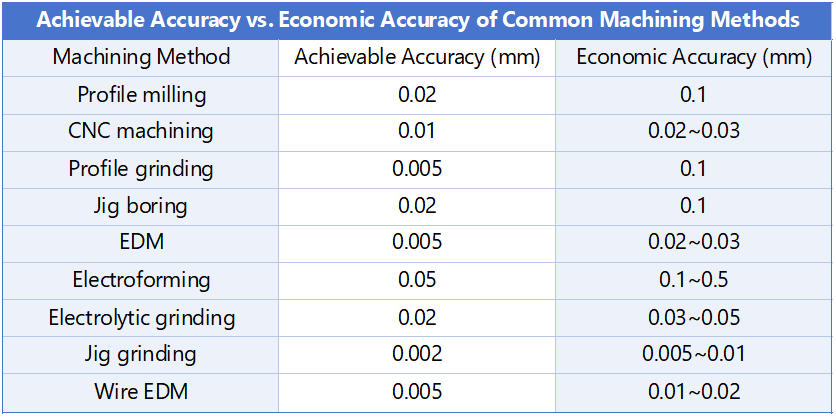
When considering mold manufacturing methods, it is essential to understand both the achievable accuracy and the economic accuracy of each process.
Machining accuracy is an absolute technical measure of how well a finished part conforms to design specifications. It reflects the degree of agreement between the actual size, shape, and position of the machined surface and the ideal geometric requirements defined on the drawing.
Economic accuracy, on the other hand, is a cost‑performance choice made on the premise that the part is “good enough to function.” It refers to selecting a precision level that keeps mold manufacturing costs, production efficiency, and long‑term operating costs within a reasonable range, while still meeting the product’s basic functional and quality requirements.
Ultimately, the choice of processing method requires a balanced, scientific analysis of both quality requirements and manufacturing costs. Below is a comparison of several common machining methods.
Mold manufacturers should continuously upgrade their equipment based on their production capabilities and financial resources, moving toward high efficiency, automation, precision, and specialization. The following areas should be prioritized:
Cutting/blanking: High‑speed saws, high‑speed grinders and laser cutting.
Rough machining: High‑speed milling machines, powerful grinders, universal tool milling machines.
Finishing: Precision CNC milling, jig grinding, optical profile grinding, CNC wire EDM (low‑speed), CNC EDM (including mirror‑finish and high‑precision types), small precision electrolytic machining, boring machines, CNC guide pin/bushing grinders, CNC engraving machines, and CMM (coordinate measuring machines).
Polishing: Lapping, ultrasonic polishing, electrolytic polishing, electro‑mechanical polishing, fluid jet polishing, chemical polishing, and combined polishing methods.
Automation: CNC machining centers, automatic wire EDM, EDM, electrolytic, and polishing composite systems.
Supporting equipment: Advanced inspection instruments, heating/cooling control systems, and auxiliary materials.

 English
  français
  Deutsch
  Español
  italiano
  русский
  português
  العربية
  dansk
dansk  Suomi
Suomi  Svenska
  norsk
norsk