When sourcing injection molds, price is often the first thing buyers look at. But does a lower-priced mold actually save you money? Not necessarily.
This article will help you build a clear framework for evaluating mold cost and break down the eight components that make up a mold quotation.
The Core Principle: Look at Total Cost, Not Just Mold Price
The true cost of a mold should not be judged by its own price alone. Instead, it must be evaluated by the combined cost of the mold + the molded parts.
For low-volume production: A simple mold — even with basic cooling and ejection — may be perfectly acceptable.
For high-volume production: You need the best possible cooling, fastest ejection, and longest mold life. Even if the mold costs more upfront, it pays off.
Why? Let's do the math:
Factor | Low-cost Mold | High-quality Mold |
Mold price | Lower | Higher |
Mold cost per part | Slightly lower | Slightly higher (but the difference is small) |
Cycle time | Longer | Shorter |
Machine occupation time | More | Less |
Total part cost | Higher | Lower |
Beyond cost per part, a high-quality mold also enables faster delivery, better production responsiveness, and less downtime.
The 8 Components of Mold Cost
A mold quotation is typically made up of the following eight elements, as shown in figure.
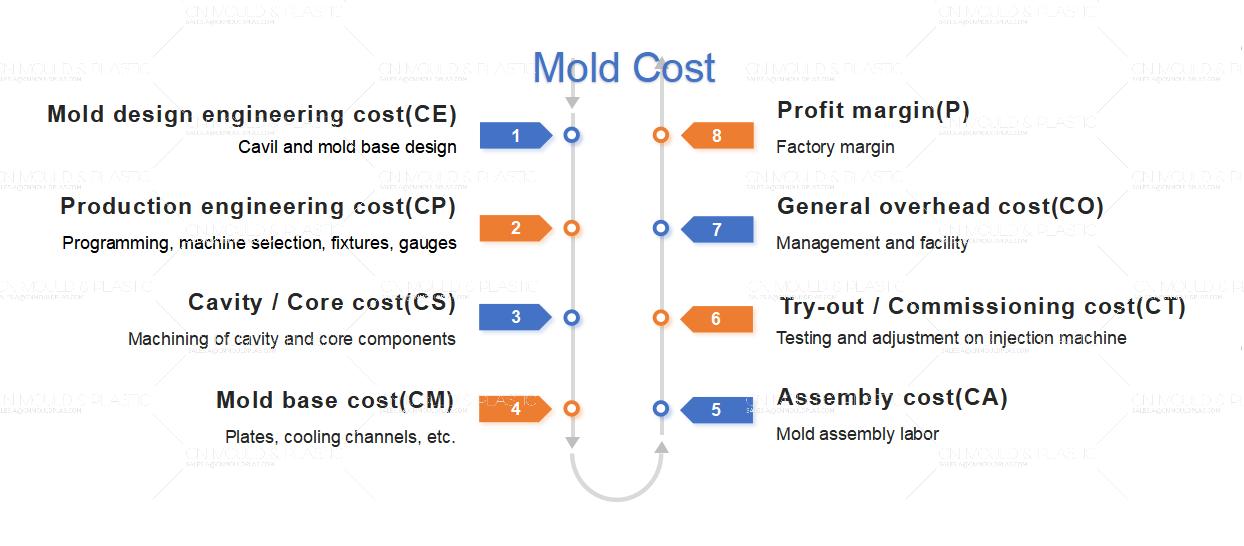
Total mold price = CE + CP + CS + CM + CA + CT + CO + P
Practical Insights into Each Cost Component
3.1 Design Engineering Cost (CE)
Standardization + CAD can significantly reduce this cost.
Cavity design workload is independent of cavity count — one cavity or ten cavities require roughly the same design effort.
Mold base design cost increases with cavity count, as the base becomes larger and more complex.
3.2 Production Engineering Cost (CP)
Standardization also simplifies production engineering — including process planning, machine selection, fixture design, and measuring equipment preparation.
3.3 Cavity / Core Cost (CS)
Modern machining methods (CNC turning/milling/grinding, EDM, wire EDM, surface finishing) have greatly reduced cavity machining costs.
Batch machining advantage: Machining multiple cavities at once takes less total time than machining them one by one.
Some specialized methods (e.g., EDM) may not be economical for a single cavity but become worthwhile for multiple cavities.
3.4 Mold Base Cost (CM)
CNC milling and deep‑hole drilling have largely replaced manual operations for mold base plates.
Mold base cost increases proportionally with cavity count — larger plates and more cooling lines drive the cost up.
3.5 Assembly Cost (CA)
Standardized designs, off‑the‑shelf components, and proper assembly tools make assembly faster and easier.
Assembly cost also increases proportionally with cavity count.
Important note: Hot runner molds have significantly higher assembly costs than cold runner molds due to more components and electrical wiring.
3.6 Try‑out / Commissioning Cost (CT)
①Mold maker handles commissioning → cost included in mold price
②Mold maker ships without commissioning → customer commissions in‑house, often at a higher total cost (production interruption, organization time)
Recommendation: Choose a mold maker that completes commissioning before shipment.
3.7 Overhead (CO) and Profit (P)
These final two components determine the final quoted price. Different factories calculate them differently, so we won’t go into further detail here.
Final Takeaway
When selecting a mold supplier, don’t focus only on the mold price — look at the total cost of ownership.
For high‑volume production, investing in a high‑quality mold almost always pays off: lower part cost, faster delivery, and more stable production.
Understanding the eight cost components helps you evaluate mold quotations more intelligently.

 English
  français
  Deutsch
  Español
  italiano
  русский
  português
  العربية
  dansk
dansk  Suomi
Suomi  Svenska
  norsk
norsk