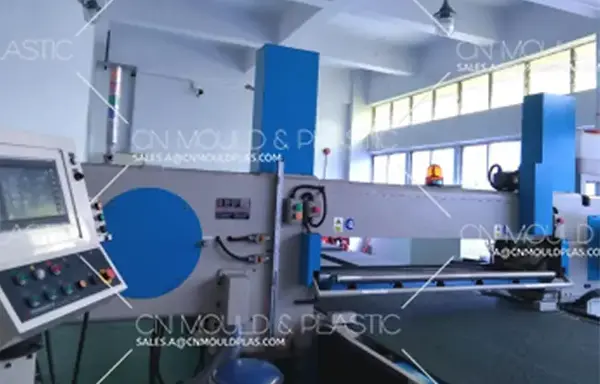
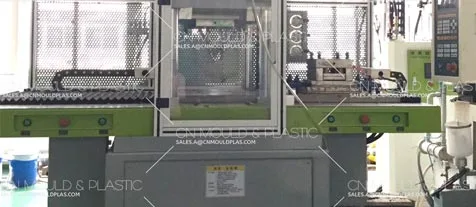
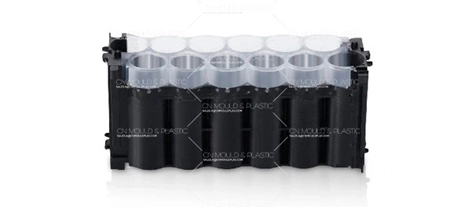
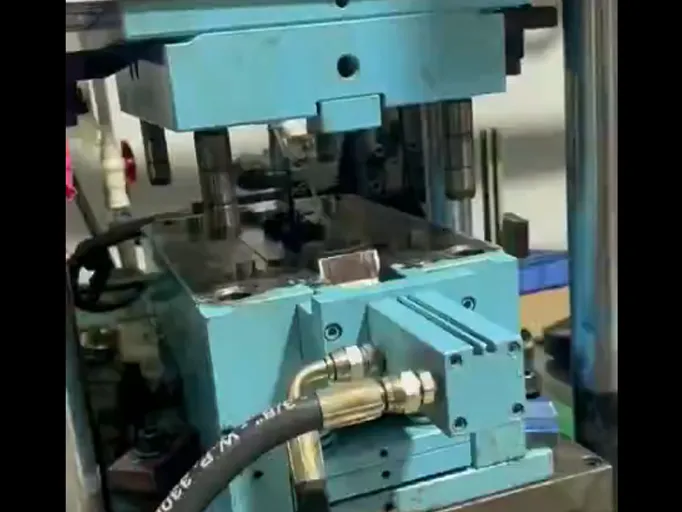
High-speed injection molding demands specific design considerations to maximize efficiency and part quality. Generally, the resin used should exhibit high flowability and a high heat deflection temperature. The part should feature a uniform, thin-walled cross-section, minimal complex side cores, and ease of ejection to shorten demolding time. The use of hot runner systems is encouraged to eliminate cooling time for runners. Adequate draft angles and appropriate surface finish are also essential to facilitate rapid part release.
Thin-walled containers represent a significant portion of high-speed injection molded products. Below are key design considerations for such containers, focusing on wall thickness, base design, and rim configuration.
Wall Thickness
Since the gate is typically positioned at the center of the container base, the ratio of wall thickness to flow length from the gate is a critical parameter for thin-walled parts.
For single-cavity molds, if the part height exceeds 100 mm, or for multi-cavity molds where part height exceeds 60 mm, this ratio must be carefully controlled within an appropriate range when determining the average wall thickness.
For containers with wall thickness ≥ 0.9 mm, the base should be thinner than the sidewalls. This design encourages hotter (lower viscosity) resin to flow into the thinner base, while cooler (higher viscosity) resin moves toward the thicker rim. This flow pattern minimizes cracking in materials like GPPS, where cold resin in thin sections increases crack susceptibility.
For containers with wall thickness < 0.9 mm, the base should be slightly thicker than the sidewalls. A uniformly restrained flow path along the sidewalls ensures resin reaches the rim evenly.
Base Design
The base should promote smooth resin flow and provide stability for freestanding placement. Key design guidelines include:
The center of the base should be ~30% thicker than the surrounding areas.
A dome-shaped protrusion (approx. Ø6.5 mm × 0.5 mm high) should be incorporated at the gate location to facilitate filling and easy gate trimming.
A gradually thickening profile from the edge to the center ensures uniform filling and consistent flow along the periphery.
Post-packing, the thicker gate area contracts inward toward the dome due to its higher temperature and subsequent shrinkage.
Rim Design
Rim design impacts both aesthetics and structural rigidity. However, rim dimensions are often constrained by sidewall thickness:
If the rim is too thick relative to the sidewall, it becomes difficult to transmit adequate holding pressure, leading to sink marks.
For spherical rim containers with wall thickness ≤ 0.6 mm, the sidewall taper should extend continuously from the thinnest section at the base to the thickest at the rim.
The rim cross-section should remain nearly constant in thickness to avoid pressure imbalances.
Ideally, the base should be thicker and the rim thinner to reduce holding pressure requirements. This configuration also helps balance pressure variations caused by core/cavity misalignment.

 English
  français
  Deutsch
  Español
  italiano
  русский
  português
  العربية
  dansk
dansk  Suomi
Suomi  Svenska
  norsk
norsk