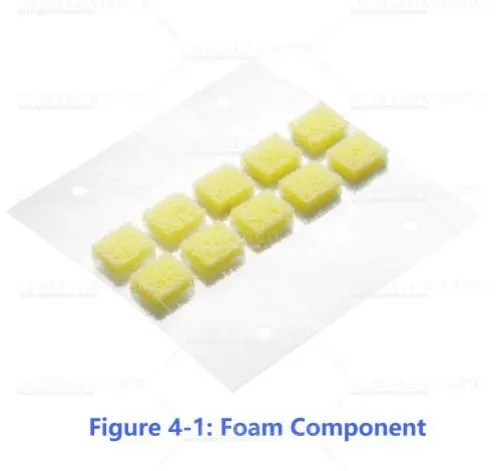
Open up a phone, earbuds, or power bank, and you'll almost always find a thin foam pad inside.
It looks insignificant. Remove it, and the device might still work — for a while. But without it, your product may start rattling, parts may loosen, and failure may come sooner than expected.
This foam is the invisible protective layer inside electronics. Let's look at what it actually does.
Absorbs Shock, Protects Sensitive Components
PCBs, camera lenses, batteries — these components are precise and fragile.
Daily bumps, drops, handheld vibration, shipping shocks — without a cushioning layer, impact forces transfer directly to the components. Foam's high-elastic structure absorbs impact energy and dissipates it, significantly reducing the chance of cracking, loosening, or failure.
Fills Assembly Gaps, Eliminates Rattling
Assembled devices are never zero-clearance. There are always tiny gaps between housing, modules, and small parts.
When the device vibrates, these gaps cause buzzing, rattling, and loose parts. Custom die-cut foam fills these gaps precisely, keeping the assembly tight and eliminating noise — improving both perceived quality and user experience.
Blocks Dust and Moisture, Protects Circuits
Electronics fear two things most: dust and moisture.
Foam bonds with excellent sealing performance, blocking housing gaps and keeping out dust and water vapor. This prevents PCB short circuits, contact oxidation, and lens contamination — effectively extending device lifespan.
Buffers Thermal Expansion, Prevents Casing Damage
Batteries and modules expand when heated and contract when cooled.
Without a buffer, repeated hard contact can cause battery swelling, casing push-out, screen lifting, and component wear. Elastic foam dynamically buffers this deformation, leaving room for expansion and contraction — preventing hard-contact damage.
Insulates and Isolates, Reducing Safety Risks
Quality EVA or anti-vibration foam has inherent insulating properties.
It isolates wiring, batteries, and PCBs — preventing short circuits, leakage, or signal interference caused by vibration and displacement. This is essential safety protection for 3C electronics and small appliances.
Anti-Slip Fixation, Keeps Parts in Place
Internal shims, mesh, and flat cables can shift under long-term vibration.
Adhesive-backed die-cut foam bonds securely and prevents slipping — holding small internal parts firmly in place for stable device operation.
Summary
Foam does the "invisible" work inside electronics — shock absorption, gap filling, dust blocking, thermal buffering, insulation, and fixation. But it's exactly this invisible work that determines whether a device lasts and performs reliably.
If you're developing an electronic product and need custom foam die-cut parts, contact us. We can process the foam into the shape you need, based on your product structure.

 English
  français
  Deutsch
  Español
  italiano
  русский
  português
  العربية
  dansk
dansk  Suomi
Suomi  Svenska
  norsk
norsk