Product Breakdown
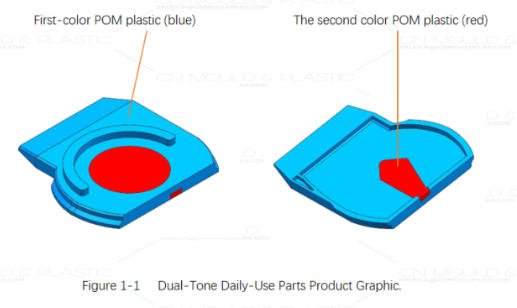
So, Figure 1-1 shows this two-shot part for some electronics guts. Average wall thickness is 1.6mm, overall size is 3.6mm x 9.6mm x 13mm. The blue part is the first shot, made of ABS, weighs 1.3g. The red bit is the second shot, also ABS, just 0.21g. The part itself is pretty simple, a classic small precision two-shot job. The mold needs to spit out 8+8 cavities per cycle (8 of each shot).
Key Design Points
1. Parting Line & Ejection Direction
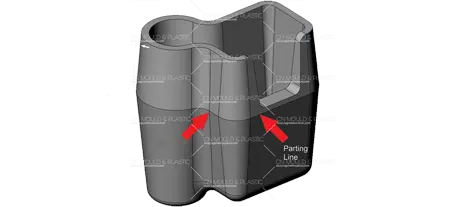
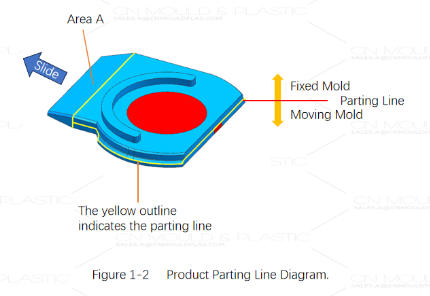
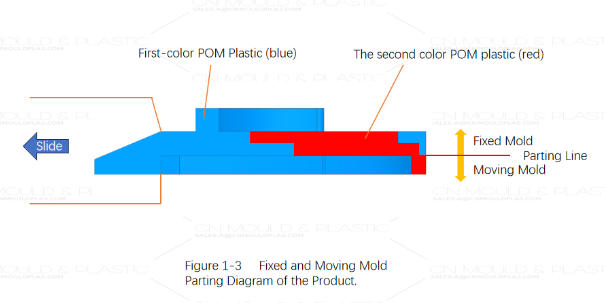
This part is tiny and simple, but there's this Area A (see Fig. 1-2a) where you absolutely cannot have a parting line flash. So, we have to use a slide to form that area. For the rest of the part, the parting line just follows the biggest outside contour, like in Figs. 1-2 and 1-3.
2. Gate Setup
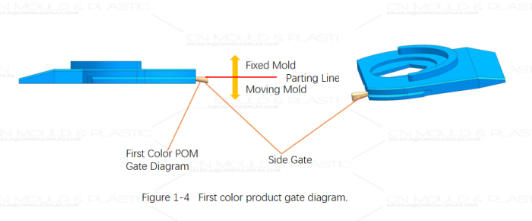
This mold's gonna run on a horizontal parallel two-shot press. The part is super small, both materials are ABS, and we've got 16 cavities total. If we used all cold runners, the sprue and runners would use up a big chunk of the total shot size – way too expensive for production. So, after thinking it through, we're going with a hot runner that feeds into a cold runner, which then leads to an edge gate for both shots. The cold runner bits will be trimmed later.
Because the part is so small and there's barely any space for runners, we made the cold runners trapezoidal in shape. To save space, the 1st shot cold runner is on the moving side (core side), and the 2nd shot one is on the fixed side (cavity side) – they're staggered so they don't get in each other's way (check Figs. 1-4 & 1-5). Fig. 1-6 shows the whole runner system layout.
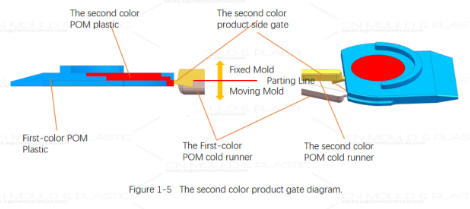
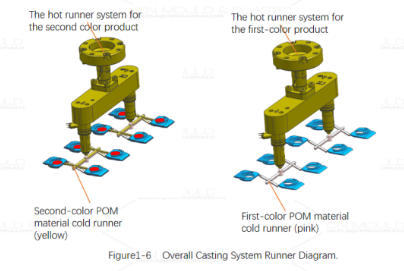
Alright, here's the tricky part (#1) in this mold: designing the runner and gate for the second*shot (the red ABS). This two-shot part is tiny, space is super tight. So, we're actually using the 1st shot's cold runner to act as the seal for the 2nd shot's cavity!
Here's how it works: The 1st shot cold runner (trapezoidal shape) is on the moving half. The cavity side for the 1st shot is just flat, no runner there. The 2nd shot cold runner is on *its* cavity plate. When we inject the second shot (red ABS), the already-molded 1st shot runner (which is sitting down in the moving half) acts as the wall that contains the red plastic and keeps it from leaking. It's a bit clever – see Figs. 1-7 through 1-10 to get the picture.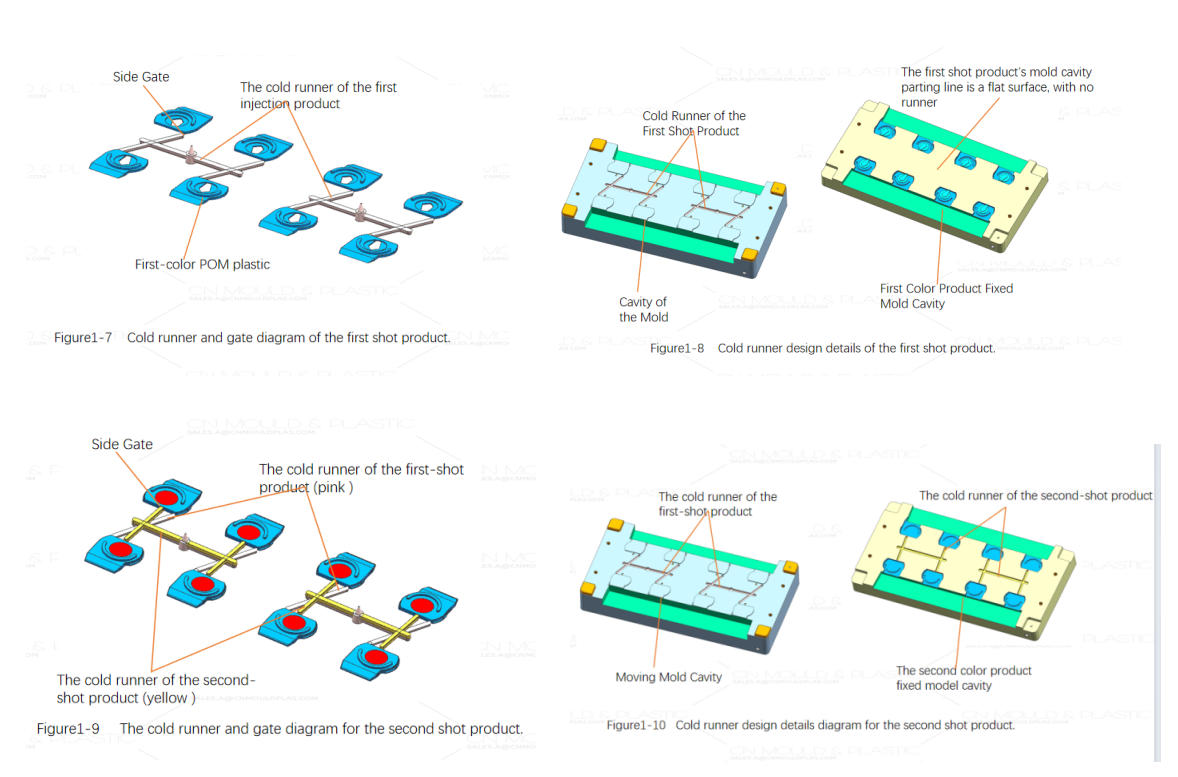

 English
  français
  Deutsch
  Español
  italiano
  русский
  português
  العربية
  dansk
dansk  Suomi
Suomi  Svenska
  norsk
norsk