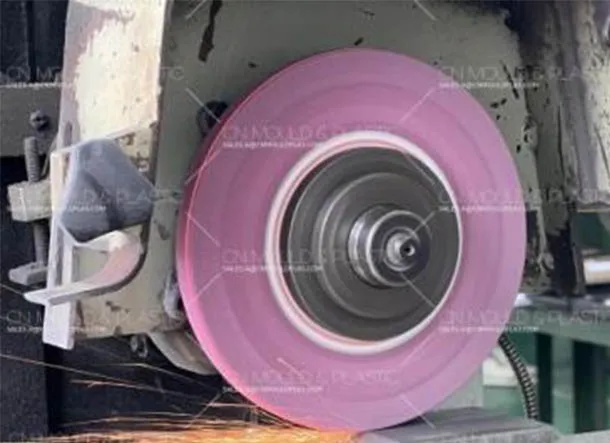
(1) Types of abrasives -- There are many types of abrasives, and they're generally classified by hardness. The hardest ones are diamonds, which include both synthetic and natural diamonds. Next are carbides, like black silicon carbide, green silicon carbide, boron carbide, and silicon boron carbide. Then there are the relatively hard corundums, such as brown corundum, white corundum, single-crystal corundum, chrome corundum, microcrystalline corundum, black corundum, zirconia corundum, and sintered corundum. The softest are oxides (also called soft chemical abrasives), including chromium oxide, iron oxide, magnesium oxide, and cerium oxide.
That's the general way of classifying them, but sometimes they're grouped into natural and synthetic abrasives instead. Since natural abrasives have drawbacks like lots of impurities, uneven quality, high prices, and limited resources of high-quality ones, almost all abrasives used nowadays are synthetic—much like how modern injection molding processes favor synthetic materials for precision components in peek injection molding.
For the types and uses of commonly used abrasives, see Table 1-1.
Table 1-1 Types and Uses of Commonly Used Abrasives
| Series | Abrasive Name | Code | Color | Hardness and Strength | Applications
Workpiece Material | Applications
Application Range |
|
| Diamond Series | Artificial Diamond | JR | Gray to Yellowish White | Hardest | Cemented Carbide, Optical Glass | Coarse Grinding, Fine Grinding |
| Natural Diamond | JT |
| Carbide Series | Black Silicon Carbide | TH | Black Translucent | Harder than corundum, brittle and sharp | Cast Iron, Brass |
| Green Silicon Carbide | TL | Green Translucent | Harder and more brittle than black silicon carbide | Cemented Carbide |
| Boron Carbide | TP | Grayish Black | Harder and more brittle than silicon carbide | Cemented Carbide, Hard Chromium |
| Corundum Series | Brown Corundum | GZ | Brown | Slightly softer than silicon carbide, good toughness, can withstand large pressure | Hardened Steel and Cast Iron |
| White Corundum | GB | White | Harder than brown corundum, slightly lower toughness, good cutting performance |
| Chrome Corundum | GG | Purple Red | Higher toughness than brown corundum |
| Single Crystal Corundum | GD | Transparent, Colorless | Multifaceted, high hardness, high strength |
| Oxide Series | Chromium Oxide | — | Dark Green | Soft | Hardened Steel, Cast Iron, Brass | Extremely Fine Precision Grinding (Polishing) |
| Iron Oxide | — | Iron Red | Softer than chromium oxide |
| Magnesium Oxide | — | White | Soft |
| Cerium Oxide | — | Earthy Yellow | Soft |
(2) Grit size of abrasives -- The grit size of an abrasive refers to the size of its particles. Abrasives can be divided into four groups based on particle size: abrasive grains, abrasive powders, micro-powders, and ultra-micro-powders.
For the first two groups – abrasive grains and abrasive powders – the grit number is indicated by the number of meshes in one inch of sieve length. You’ll see this marked with a "#" symbol after the number. Like, 240# means there are 240 holes in one inch of the sieve. The bigger the grit number, the finer the particles.
As for micro-powders and ultra-micro-powders, their grit numbers are based on the actual particle size, marked with a "W" in front of the size number. Sometimes they can also be converted to sieve numbers. For example, W20 means the actual particle size is between 20 and 14 micrometers, which is equivalent to 500# in sieve terms.
Within each grit size, there are coarse, medium, and fine particles. Medium particles are the basic grit in abrasive powders – they’re the main factor determining the abrasive’s grinding ability and make up a large proportion of the grit composition. Abrasive powders where the basic grit accounts for 35% to 40% can have this proportion increased to around 60% after another round of centrifugal separation. Practice shows that after separation, the grinding ability of the abrasive powder is 20% better than before.
Fine particles play only a small role in grinding. Coarse particles are not only bad for the quality of the workpiece being ground but also reduce grinding efficiency, so their quantity should be kept as low as possible in the grit composition. That’s why, both for grinding efficiency and workpiece quality, it’s important for abrasive particles to be uniform.
Details like the classification, particle size ranges, separation and measurement methods, and main uses of abrasive powders, micro-powders, and ultra-micro-powders are in Table 1-2. You won’t find the abrasive grain group with grit sizes from 12# to 80# in Table 1-2 – that’s because their particles are too large to be used as abrasives for grinding processes.
| Group | Grit Size Number | Equivalent Sieve Mesh | Particle Size/μm | American A-O Standard | Soviet Fractional Agent | Sorting and Determination Method | Application |
| Abrasive Powder | 100# | — | 160-125 | — |
| Sorted by screening method, determined by combined analysis and microscopic analysis | Abrasive Tools Emery Cloth Sandpaper Coarse Grinding |
| 120° | 125-100 |
|
| 150° | 100-80 |
|
| 180° | 80-63 | 5′ |
| 240° | 63-50 | 7′ |
| 280° | 50-40 |
|
| Micro powder | W40 | 320 | 40-28 |
| 10′ | Sorted by water separation method, determined by microscopic analysis | Coarse Grinding |
| W28 | 400 | 28-20 | 302 | 15′ |
| W20 | 500 | 20-14 | 302′/2 | 30′ |
| W14 | 600 | 10月14日 | 303 | 60′ |
| W10 | 800 | 10月7日 | 303′/2 | 120′ |
| W7 | 1000 | 7月5日 | 304 | 240′ |
| W5 | 1200 | 5-3.5 | 305 | 480′ |
|
|
| Ultra-fine Powder | W3.5 | 1500 | 3.5-2.5 | 306 | — | Sorted by water separation method, determined by microscopic analysis | Semi-precision Grinding |
| W2.5 | 200 | 2.5-1.5 | 307 |
| W1.5 | 2500 | 1.5-1 | 308 |
| W1 | 3000 | 1-0.5 | 309 |
| W0.5 |
| 0.5-Extra Fin |
|
(3) Abrasive hardness – Abrasive hardness is one of the basic properties of abrasives, and it’s a totally different concept from the hardness of abrasive tools. Abrasive hardness refers to the ability of the abrasive’s surface to resist local external forces. On the other hand, the hardness of an abrasive tool (like an oilstone) is about how firmly the binder holds the abrasive grains together when they’re under external pressure. A harder object can scratch a softer one, meaning it can damage the softer object’s surface. Grinding works by using the difference in hardness between the abrasive and the workpiece being ground. The harder the abrasive, the stronger its cutting power.
(4) Abrasive strength – Abrasive strength is about how sturdy the abrasive itself is. To put it simply, it’s the ability of the abrasive grains to withstand external pressure without breaking, even when their edges are still sharp. Abrasives with poor strength will have their grains break apart quickly, resulting in low cutting power and a short service life. That’s why, in addition to high hardness, abrasive grains need to have enough strength to perform grinding well.

 English
  français
  Deutsch
  Español
  italiano
  русский
  português
  العربية
  dansk
dansk  Suomi
Suomi  Svenska
  norsk
norsk