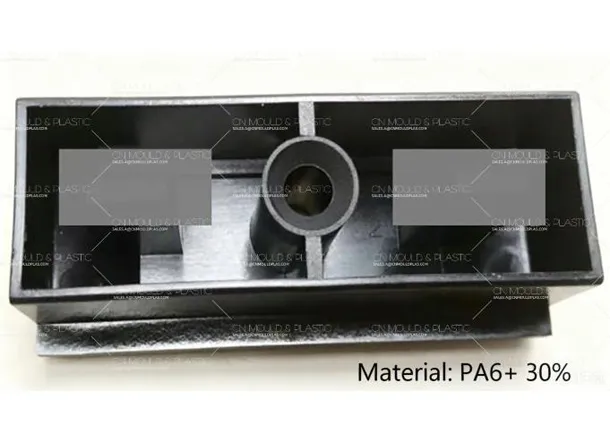
PP or PC for electrical brackets? Most people start by comparing price and tensile strength. But the real deal-breaker is usually something else: Does your bracket have critical alignment features?
I’m talking about snap-fit gaps, positioning bosses, or screw hole spacing that must match other parts precisely. If it does, PC is worth the premium. If it doesn't, modified PP is cheaper and gets the job done.
Why is there such a stark difference? Let's break it down.
PP: The Hidden Cost of Shrinkage
PP is a semi-crystalline polymer. During injection molding, it crystallizes rapidly, usually reaching a crystallinity of 50% to 70%.
This high crystallinity gives PP good stiffness, hardness, and heat resistance. But it comes with a major trade-off: high mold shrinkage and poor dimensional stability.
If your bracket has snaps or screw holes, and the shrinkage isn't dialed in perfectly, assembly will be a nightmare.
And there's a sneakier issue: post-molding shrinkage. Because PP’s glass transition temperature (Tg) is below room temperature, the part continues to crystallize after it’s ejected. Most of this post-shrinkage happens within 24 hours.
This means a part that measures perfectly right off the machine might be out of tolerance by tomorrow. For precision mating parts, that's a ticking time bomb.
PC: Stable, but It Comes at a Cost
PC is an amorphous polymer. It shrinks uniformly as it cools, with a low mold shrinkage rate (usually 0.4% to 0.8%). This allows for highly precise parts.
The core value of PC for brackets isn't that it’s inherently "stronger" than PP—it’s that its dimensional performance is predictable and consistent from batch to batch.
But this precision isn't free. PC has a high melt viscosity, requires high injection pressures, and demands a more robust mold and machine. It's also notch-sensitive and prone to internal stress, which usually means it needs an annealing process to relieve stress and stabilize dimensions.
You are paying for PC's precision with higher tooling requirements and extra processing steps.
How to Choose: Look at Three Things
1. Does it have precision mating features?
If it’s just a support or a shield, modified PP is perfectly fine. If it has snaps, positioning bosses, or screw holes that must align perfectly with a PCB or housing, PC’s dimensional stability is worth the extra cost. This is the most important rule. Everything else is secondary.
2. What’s the volume and cost sensitivity?
For high-volume, cost-sensitive brackets without precision requirements, modified PP’s cost advantage is undeniable. But for lower volumes, or when tolerances push the limits of PP, the extra cost of PC is usually cheaper than dealing with assembly line rework.
3. Can your molding conditions keep up?
Choosing PC isn't just about buying the pellets. If your mold and injection molding machine can't handle the high pressures and temperatures required, PC will fight back with internal stress, cracking, or silver streaks. If you can't process it right, the extra material cost is wasted.

The Bottom Line
PP brackets win on cost and large-part molding. PC brackets win on dimensional stability.
If you go with PP, make sure you have the right modified grade. If you go with PC, make sure your molding conditions can actually handle it.

 English
 français
 Deutsch
 Español
 italiano
 русский
 português
 العربية
 dansk
 Suomi
 Svenska
 norsk