You know that little bit of leftover flash on the parting line? If it’s not removed properly, it creates a leak path. And that’s enough to ruin an otherwise perfect seal.
So let's talk about deflashing — the four main methods, and which one actually protects your seals.
Why Flash Happens
In compression molding, you have to overfill the cavity a bit to make sure it fills completely. The excess rubber squeezes out through the parting line and becomes flash. After the part is vulcanized, that flash has to be trimmed off. That's deflashing.
For sealing products, this step isn't cosmetic. A rough edge, a tear, or an uneven cut can be the difference between a seal that works and one that fails in the field.

Manual Deflashing
This is the old-school way. Scissors, blades, or whatever hand tool works. It costs almost nothing, and it can handle a lot of general rubber parts. That's why it's still common for small batches and simple products.
The problem is consistency. One part might come out perfect, the next one might get nicked or cut too deep. For seals that need tight tolerances or high volume, manual trimming is a gamble.
There's also a variant where you mount the part on a rotating shaft and use an abrasive stick to grind off the flash. It works for O-rings and similar round parts, but it's still manual.
Mechanical Cutting
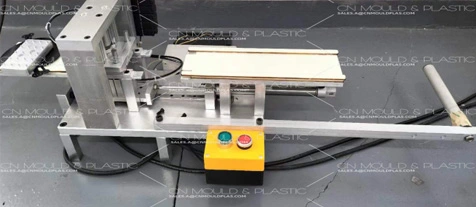
This uses a lathe or similar machine to cut the flash away. Harder parts can be chucked directly. Most need a custom fixture. The tool has to be sharp, and you should always test a couple of pieces before running the batch.
It's good for rotationally symmetric parts in medium volumes, or when you need a nice appearance. Oil seal trimming machines and rubber finishing machines are common equipment for this.
Mechanical Punching
A press and a punch die stamp off the flash. The die is designed around the press and the flash shape. It's fast — single parts or whole sheets. Works well for parts that can lie flat on the die.
Cryogenic Deflashing
This is the one that changed the game for high-volume seal production. Liquid nitrogen cools the parts down to a very low temperature. The thin flash becomes brittle, but the thicker body stays flexible. Then the parts are tumbled or blasted, and the brittle flash breaks off cleanly.
The result is consistent, repeatable, and gentle on the seal. But there's a catch: the flash thickness needs to be under 0.2 mm, and it can't be thicker than the minimum wall thickness of the part. If the flash is too thick, even cryogenic deflashing won't save you.
Which Method Should You Use?
Small batch, simple part, loose tolerance → manual deflashing is fine.
Medium volume, rotational part, good appearance → mechanical cutting works.
Flat part, high volume, simple shape → mechanical punching is fast.
Sealing product, high volume, tight tolerance → cryogenic deflashing is the clear winner.
For seals and O-rings, the deflashing method isn't a minor detail. It's a key factor in whether your product leaks or lasts.

 English
 français
 Deutsch
 Español
 italiano
 русский
 português
 العربية
 dansk
 Suomi
 Svenska
 norsk